

Albert v. GTL, MD, Settlement, Price-Fixing, 2024
Download original document:
Document text
Document text
This text is machine-read, and may contain errors. Check the original document to verify accuracy.
Case 8:20-cv-01936-LKG Document 318 Filed 10/31/24 Page 1 of 20

IN THE UNITED STATES DISTRICT COURT
FOR THE DISTRICT OF MARYLAND
ASHLEY ALBERT, et al.,
Plaintiffs,
v.
GLOBAL TEL*LINK CORP., et al.,
Defendants.

)
)
)
)
)
)
)
)
)
)
)

Civil Action No. 20-cv-01936-LKG
Dated: October 31, 2024

MEMORANDUM OPINION AND ORDER ON PLAINTIFFS’
MOTION FOR PRELIMINARY APPROVAL OF THE SETTLEMENT
I. INTRODUCTION
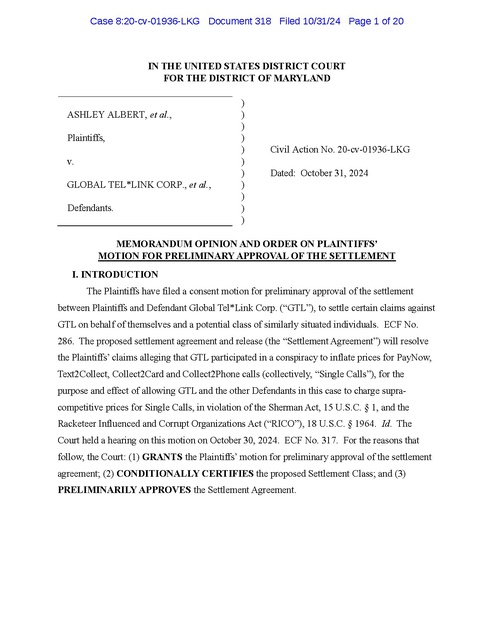
The Plaintiffs have filed a consent motion for preliminary approval of the settlement
between Plaintiffs and Defendant Global Tel*Link Corp. (“GTL”), to settle certain claims against
GTL on behalf of themselves and a potential class of similarly situated individuals. ECF No.
286. The proposed settlement agreement and release (the “Settlement Agreement”) will resolve
the Plaintiffs’ claims alleging that GTL participated in a conspiracy to inflate prices for PayNow,
Text2Collect, Collect2Card and Collect2Phone calls (collectively, “Single Calls”), for the
purpose and effect of allowing GTL and the other Defendants in this case to charge supracompetitive prices for Single Calls, in violation of the Sherman Act, 15 U.S.C. § 1, and the
Racketeer Influenced and Corrupt Organizations Act (“RICO”), 18 U.S.C. § 1964. Id. The
Court held a hearing on this motion on October 30, 2024. ECF No. 317. For the reasons that
follow, the Court: (1) GRANTS the Plaintiffs’ motion for preliminary approval of the settlement
agreement; (2) CONDITIONALLY CERTIFIES the proposed Settlement Class; and (3)
PRELIMINARILY APPROVES the Settlement Agreement.

Case 8:20-cv-01936-LKG Document 318 Filed 10/31/24 Page 2 of 20

II. FACTUAL BACKGROUND AND PROCEDURAL HISTORY 1
A. Factual Background
The Plaintiffs’ Claims
This putative class action matter involves claims that the Defendants in this matter
participated in a conspiracy to inflate prices for Single Calls, for the purpose and effect of
allowing the Defendants to charge supra-competitive prices for Single Calls, in violation of the
Sherman Act and RICO. See generally ECF No. 205. The Plaintiffs, Ashley Albert, Ashley
Baxter, Lupei Zhu, and Rhonda Howard, are individuals who allegedly paid inflated prices for
the Single Calls sold by the Defendants. ECF No. 205 at 14. Relevant to the pending motion,
the Plaintiffs allege that GTL implemented the alleged price-fixing scheme for Single Calls it
sold. Id. at 6-7.
The Plaintiffs commenced this putative class action matter on June 29, 2020. ECF No. 1.
Thereafter, the parties filed several dispositive motions and have engaged in discovery. ECF
No. 287 at 8. The Settlement Agreement between the Plaintiffs and GTL was executed on
September 4, 2024. Id.
The Settlement Agreement
The proposed Settlement would establish a “Settlement Class” defined as follows:
All persons and entities that, during the period January 1, 2010, until
the date of preliminary approval of this Settlement Agreement, paid:
(i) a flat fee of $14.99 through Securus’s PayNow program; (ii) a
flat fee of $14.99 through GTL’s Collect2Card program; (iii) a flat
fee of $9.99 through the Securus’s Text2Connect program; and/or
(iv) a flat fee of $9.99 through GTL’s Collect2Phone program.
ECF No. 286-4 at 20.
The following persons and entities are excluded from the Settlement Class:
Defendants and their employees, subsidiaries, affiliates,
predecessors, officers, directors, legal representatives, heirs, and
successors; co-conspirators; federal state, and local governmental
entities; and the judge, judicial officers, and associated court staff
assigned to this case and their immediate family members.

The facts recited herein are taken from the amended complaint, the Plaintiff’s motion for preliminary
approval of the settlement, and the memorandum of law and exhibits in support thereof. ECF Nos. 205,
286, 287, 286-3, 286-4. Unless otherwise stated, the facts recited herein are undisputed.

1

2

Case 8:20-cv-01936-LKG Document 318 Filed 10/31/24 Page 3 of 20

Id.
The key provisions of the Settlement Agreement are summarized below:
First, Section II(A)(1) of the Settlement Agreement sets forth the terms of the settlement
payment and provides that, “in consideration for the release of the Released Claims and the
dismissal with prejudice of the Action, within fourteen business days of the later of (i) the Court’s
grant of Preliminary Approval or (ii) the date on which GTL is provided with wiring information
for the Escrow Account, GTL shall pay or cause to be paid $17,000,000.00 (seventeen million
U.S. dollars) into the Settlement Fund.” ECF No. 286-4 at 9. Section II(A)(1)(b) further provides
that “the payment . . . shall constitute the total Settlement Amount and GTL shall have no other
payment obligations to the Settlement Class or owe any further amount under this Settlement
Agreement, and the obligations described in Section II(A)(2) shall continue so long as this
Settlement Agreement remains in effect . . . [, and] [e]ach Class Member shall look solely to the
Net Settlement Amount for settlement and satisfaction . . . of all Released Claims[.]” Id.
Second, Section II(A)(2) of the Settlement Agreement provides that GTL will provide
cooperation to the Plaintiffs as the Plaintiffs continue with the prosecution of their claims against
the remaining Defendants, including providing relevant data, documents, information and
witnesses concerning the allegations in the case, as defined in the Settlement Agreement. Id. at
9-13.
Third, Section II(B)(2) of the Settlement Agreement contains a release provision, which
provides that:
Upon the Date of Final Judgment, the Releasing Parties shall
completely release, acquit, and forever discharge the GTL Released
Parties from any and all existing or potential, known or unknown,
claims, demands, actions, suits, causes of action, upon any theory of
law or equity, whether class, individual, parens patriae, or otherwise
in nature (whether or not any member of the Settlement Class has
objected to the Settlement Agreement or makes a claim upon or
participates in the Settlement Fund, whether directly,
representatively, derivatively or in any other capacity) that the
Releasing Parties ever had, now has, or hereafter can, shall, or may
ever have, on account of, or in any way arising out of, any and all
known and unknown, foreseen and unforeseen, suspected or
unsuspected, actual or contingent, liquidated or unliquidated claims,
causes of action, injuries, losses, civil or other penalties, restitution,
3

Case 8:20-cv-01936-LKG Document 318 Filed 10/31/24 Page 4 of 20

disgorgement, damages, and the consequences thereof that have
been asserted, or could have been asserted, under federal or state law
arising from or in connection with any act or omission during the
Settlement Class Period relating to or referred to in the Action,
arising from the factual predicate of the Action, or any conduct that
was challenged, raised or alleged in the Action, including any
restraint of trade or pattern of racketeering that had the purpose and
effect of inflating prices for Single Calls (collectively, the “Released
Claims”).
Id. at 13. The release provision further provides, in relevant part, that:
During the period after the expiration of the deadline for submitting
an opt-out notice, as determined by the Court, and prior to Final
Judgment, all Releasing Parties who have not submitted a valid
request to be excluded from the Settlement Class shall be
preliminarily enjoined and barred from asserting any Released
Claims against the GTL Released Parties. The release of the
Released Claims will become effective as to all Releasing Parties
upon Final Judgment. Upon Final Judgment, the Releasing Parties
further agree that they will not file any other suit against the GTL
Released Parties arising out of or relating to the Released Claims.
Id. at 14.
Fourth, Section II(B)(3) of the Settlement Agreement contains a waiver provision, which
provides that:
[T]he Releasing Parties hereby expressly waive and release, solely
with respect to the Released Claims, upon the Date of Final
Judgment, any and all provisions, rights, and benefits conferred by
Section 1542 of the California Civil Code . . . and Section 20-7-11
of the South Dakota Codified Laws . . . or by any law, regulation or
rule of any state or territory of the United States, or principle of
common law, which is similar, comparable, or equivalent to Section
1542 of the California Civil Code or Section 20-7-11 of the South
Dakota Codified Laws.” Each Releasing Party may hereafter
discover facts other than or different from those which he, she, they,
or it knows or believes to be true with respect to the claims which
are released pursuant to the provisions of Section II(B)(2), but each
Releasing Party hereby expressly waives and fully, finally, and
forever settles and releases, upon the Date of Final Judgment, any
known or unknown, suspected or unsuspected, contingent or noncontingent claim that the Releasing Parties have agreed to release
pursuant to Section II(B)(2), whether or not concealed or hidden,
without regard to the subsequent discovery or existence of such
different or additional facts.

4

Case 8:20-cv-01936-LKG Document 318 Filed 10/31/24 Page 5 of 20

Id. at 14-15.
Fifth, Section II(C) of the Settlement Agreement sets forth the process for claims
administration. Id. at 15. In this regard, the Settlement Agreement provides that, pursuant to the
Court’s preliminary approval Order, and subject to Court approval, “Interim Co-Lead Counsel
shall engage a qualified Claims Administrator” and that the Claims Administrator “shall
effectuate the notice plan approved by the Court in the Preliminary Approval Order, shall
administer and calculate the claims, and shall oversee distribution of the Net Settlement Fund in
accordance with the Plan of Distribution . . .[and] also shall assist in the development of the Plan
of Distribution and the resolution of any disputes regarding the Plan of Distribution.” Id. at 15.
Sixth, Section II(D) of the Settlement Agreement sets forth the terms of the Settlement
Fund’s administration, and provides that “the Settlement Fund shall be administered pursuant to
the provisions of [the] Settlement Agreement and subject to the Court’s continuing supervision
and control, until the funds in the Settlement Fund are fully distributed[.]” Id. at 16; see id. at
16-19. In this regard, Section II(D)(1-2) further provides that the Settlement Fund “shall be
established within an Escrow Account and administered by an Escrow Agent at a bank
designated by Interim Co-Lead Counsel” and that “[a]ll funds held in the Escrow Account shall .
. . remain subject to the jurisdiction of the Court, until such time as such funds shall be
distributed pursuant to this Agreement and/or further order(s) of the Court. Id. In addition,
Section II(D)(9) sets forth the terms for the Plan of Distribution and provides that:
After the Date of Final Approval, the Net Settlement Fund shall be
disbursed in accordance with a plan of distribution to be approved
by the Court. The Class Members shall look solely to the Net
Settlement Fund for settlement and satisfaction of any and all
Released Claims from Released Parties. The timing of a motion to
approve a plan of distribution of the Net Settlement Fund created by
this Settlement Agreement shall be in the discretion of Interim CoLead Counsel, and may be combined with a plan to distribute
proceeds from other settlements in this Action.
Id. at 19.
Seventh, Section II(F)(5) of the Settlement Agreement sets forth the plan for notice to the
proposed Settlement Class members, and provides that:
The Settlement Class Notice shall provide for a right of exclusion,
as set forth in Section II(F)(4). The Settlement Class Notice shall
5

Case 8:20-cv-01936-LKG Document 318 Filed 10/31/24 Page 6 of 20

also provide for a right to object to the proposed Settlement.
Individual notice of the Settlement to all Settlement Class Members
who can be identified through reasonable effort shall be mailed,
emailed and/or sent via text message to the Settlement Class in
conformance with a notice plan to be approved by the Court. Interim
Co-Lead Counsel will undertake reasonable efforts to notify
potential Settlement Class Members of the settlement, including
publication notice through traditional, digital, and/or social media
sources likely to reach Settlement Class Members. The timing of a
motion to approve notice to the Settlement Class of this Settlement
Agreement (“Notice Motion”) shall be in the discretion of Interim
Co-Lead Counsel, and may be combined with notice of other
settlements in this Action. The Notice Motion shall include a
proposed form of, method for, and date of dissemination of notice.
Id. at 22. Pursuant to Section II(F)(6), “The costs of providing Settlement Class Notice to
Settlement Class Members shall be paid by the Escrow Agent from the Settlement Fund[.]” Id.
Lastly, Section II(F)(9) of the Settlement Agreement sets forth the terms for payment of
Class Counsel Fees and Expenses and Other Costs, and provides, in relevant part, that:
GTL shall have no responsibility for any other costs, including
Interim Co- Lead Counsel’s attorneys’ fees, costs, and expenses or
the fees, costs, or expenses of any Plaintiff’s or Class Member’s
respective attorneys, experts, advisors, or representatives, provided,
however, that with respect to the Action, including this Settlement
Agreement, GTL shall bear its own costs and attorneys’ fees.
Subject to Interim Co-Lead Counsel’s sole discretion as to whether
to apply and the timing of such an application, Interim Co-Lead
Counsel may apply to the Court for an attorney fee award,
reimbursement of expenses and costs, and/or service awards for
class representatives, to be paid from the proceeds of the Settlement
Fund. GTL shall have no responsibility, financial obligation, or
liability for any such fees, costs, expenses, or service awards.
Id. at 24-25. 2

On September 24, 2020, the Court appointed the law firms of Handley Farah & Anderson PLLC and
Cohen Milstein Sellers & Toll PLLC to serve as interim co-lead class counsel in this matter. ECF No. 58.
The firm of Handley Farah & Anderson PLLC spearheaded the investigation into the Defendants’ alleged
actions which led to the filing of this litigation and its attorneys have considerable experience litigating
complex class actions alleging violations of the antitrust and RICO laws. ECF No. 48 at 10. The firm of
Cohen Milstein Sellers & Toll PLLC has particular skills and expertise in enforcing federal and state
antitrust laws, with thirty lawyers dedicated to antitrust practice specifically and possesses the resources
and the expertise to litigate large antitrust class successfully through trial and appeal. Id. at 14.

2

6

Case 8:20-cv-01936-LKG Document 318 Filed 10/31/24 Page 7 of 20

B. Relevant Procedural History
The Plaintiffs commenced this putative class action matter on June 29, 2020. ECF No. 1.
On September 24, 2024, the Plaintiffs filed a motion for preliminary approval of the settlement, a
memorandum in support thereof, and documents related thereto. ECF Nos. 286, 287, 286-2, 2863, and 286-4. The Court held a hearing on the Plaintiffs’ motion on October 30, 2024. ECF No.
317.
III.

STANDARDS FOR DECISION
A. Preliminary Approval Of Class Action Settlement
The decision of “[w]hether to preliminarily approve a class action settlement lies within

the sound discretion of the district court.” Stephens v. Farmers Rest. Grp., 329 F.R.D. 476, 482
(D.D.C. 2019). In this regard, courts have recognized that “there is an overriding public interest
in favor of settlement, particularly in class action suits.” Lomascolo v. Parsons Brinckerhoff,
Inc., 2009 WL 3094955, at *10 (E.D. Va. Sept. 28, 2009) (citing Cotton v. Hinton, 559 F.2d 1326,
1331 (5th Cir. 1977)). But, when the parties are seeking class certification and settlement at the
same time, the proposed settlement agreement requires closer judicial scrutiny. Stephens,
329 F.R.D. at 482 (internal quotations and citations omitted); see also Manual for Complex
Litigation (Fourth) § 21.612 (2004).
In this regard, the Court’s analysis of whether a proposed Rule 23 class action settlement
is fair and reasonable involves a two-step process. First, the Court determines whether the
settlement is “within the range of possible approval,” such that there is “probable cause to notify
the class members of the proposed settlement.” Starr v. Credible Behav. Health, Inc., 2021 WL
2141542, at *5 (D. Md. May 26, 2021) (quoting Horton v. Merrill Lynch, Pierce, Fenner &
Smith, Inc., 855 F. Supp. 825, 827 (E.D.N.C. 1994)). “At this initial stage, the Court must make
‘a preliminary determination on the fairness, reasonableness, and adequacy of the settlement
terms’ and ‘direct the preparation of notice of the certification, proposed settlement, and date of
the final fairness hearing.’” Id. (quoting Manual for Complex Litigation § 21.632).
To determine whether it can give preliminary approval to the Settlement Agreement, the
Court looks to the factors in Fed. R. Civ. P. 23(e)(2). This Rule provides that the Court may find
that a settlement is fair, reasonable, and adequate after considering whether:

7

Case 8:20-cv-01936-LKG Document 318 Filed 10/31/24 Page 8 of 20

(A)
(B)
(C)

the class representatives and class counsel have adequately
represented the class;
the proposal was negotiated at arm’s length;
the relief provided for the class is adequate, taking into
account:
(i)
(ii)

the costs, risks, and delay of trial and appeal;
the effectiveness of any proposed method of
distributing relief to the class, including the method of
processing class-member claims;
(iii) the terms of any proposed award of attorney’s fees,
including timing of payment; and
(iv) any agreement required to be identified under Rule
23(e)(3); and
(D)

the proposal treats class members equitably relative to each
other.

Fed. R. Civ. P. 23(e)(2)(A)-(D). And so, “[p]reliminary approval should be granted when a
proposed settlement is ‘within the range of possible approval,’ subject to further consideration
after a final fairness hearing at which interested parties have had an opportunity to object.”
Shaver v. Gills Eldersburg, Inc., 2016 WL 1625835, at *2 (D. Md. Apr. 25, 2016) (quoting
Benway v. Res. Real Est. Servs., LLC, 2011 WL 1045597, at *4 (D. Md. Mar. 16, 2011)). If the
Court preliminarily approves the proposed settlement, the second step is a “fairness hearing to
determine whether the settlement is ‘fair, reasonable, and adequate’ for all class members and
thus should receive final approval.” Starr, 2021 WL 2141542, at *5 (quoting § 21.634); see
Grice v. PNC Mortg. Corp. of Am., 1998 WL 350581, at *2 (D. Md. May 21, 1998).
B. Class Certification
To conditionally certify a class, the Court must confirm that this putative class action
comports with Rules 23(a) and (b) of the Federal Rules of Civil Procedure. See Starr, 2021 WL
2141542, at *3 (citing Amchem Prods., Inc. v. Windsor, 521 U.S. 591, 619–20 (1997)); see also
Shaver, 2016 WL 1625835, at *3 (“Where a class-wide settlement is presented for approval prior
to class certification, there must also be a preliminary determination that the proposed settlement
class satisfies the prerequisites set forth in Federal Rule of Civil Procedure 23(a) and at least one
of the subsections of Rule 23(b).”). Rule 23(a) provides that:
One or more members of a class may sue or be sued as representative
parties on behalf of all members only if:
(i)

the class is so numerous that joinder of all members is
impracticable;
8

Case 8:20-cv-01936-LKG Document 318 Filed 10/31/24 Page 9 of 20

(ii) there are questions of law or fact common to the class;
(iii) the claims or defenses of the representative parties are typical of
the claims or defenses of the class; and
(iv) the representative parties will fairly and adequately protect the
interests of the class.
Fed. R. Civ. P. 23(a).
To meet the numerosity requirement under Rule 23(a), there must be a showing that the
proposed class is so numerous that “joinder of all members is impractical.” Starr, 2021 WL
2141542, at *3 (quoting Fed. R. Civ. P. 23(a)). In this regard, the United States Court of Appeals
for the Fourth Circuit has held that a class with more than 30 members generally satisfies this
requirement. See id. (citing Williams v. Henderson, 129 F. App’x 806, 811 (4th Cir. 2005)).
The commonality requirement is satisfied when the prospective class members share the
same central facts and applicable law. Id. (citing Cuthie v. Fleet Rsrv. Ass’n, 743 F. Supp. 2d
486, 499 (D. Md. 2010)). In addition, to meet the typicality requirement, “[t]he claims need not
be identical, but the claims or defenses must have arisen from the same course of conduct and
must share the same legal theory.” Id. (citing Peoples v. Wendover Funding, Inc., 179 F.R.D.
492, 498 (D. Md. 1998)).
In addition, a class action is appropriate only when both class representatives and class
counsel adequately protect the interests of the class. Bell v. Brockett, 922 F.3d 502, 510 (4th Cir.
2019). As to the representation of class counsel, “[t]he adequacy-of-representation requirement
centers on: (1) class counsel’s competency and willingness to prosecute the action and (2)
whether any conflict of interest exists between the named parties and the class they represent.”
Id. (citing Robinson v. Fountainhead Title Grp. Corp., 252 F.R.D. 275, 288 (D. Md. 2008)). And
so, “[r]epresentation is adequate if the [Plaintiff’s] attorneys are qualified and able to prosecute
the action on behalf of the class.” Id. (citing Cuthie, 743 F.2d at 499).
Lastly, Federal Rule of Civil Procedure 23(b)(3) provides that:
A class action may be maintained if Rule 23(a) is satisfied and if: . . . . (3)
the court finds that the questions of law or fact common to class members
predominate over any questions affecting only individual members, and
that a class action is superior to other available methods for fairly and
efficiently adjudicating the controversy.
Fed. R. Civ. P. 23(b)(3). “Where the purported class members were subject to the same harm
resulting from the defendant’s conduct and the ‘qualitatively overarching issue’ in the case is the

9

Case 8:20-cv-01936-LKG Document 318 Filed 10/31/24 Page 10 of 20

defendant’s liability, courts generally find the predominance requirement to be satisfied.” Starr,
2021 WL 2141542, at *4 (citing Stillmock v. Weis Mkts., Inc., 385 F. App’x 267, 273 (4th Cir.
2010)). The Court must also consider:
(A)
(B)
(C)
(D)

the class members’ interests in individually controlling the
prosecution or defense of separate actions;
the extent and nature of any litigation concerning the controversy
already begun by or against class members;
the desirability or undesirability of concentrating the litigation of the
claims in the particular forum; and
the likely difficulties in managing a class action.

Fed. R. Civ. P. 23(b)(3)(A)-(D); see also Shaver, 2016 WL 1625835, at *3.
III.

ANALYSIS
In their motion for preliminary approval of the settlement, the Plaintiffs request that the

Court: (1) grant preliminary approval of the Settlement Agreement; (2) certify the proposed
Settlement Class; (3) appoint the named Plaintiffs in this litigation— Ashley Albert, Ashley
Baxter, Lupei Zhu, and Rhonda Howard —as representatives of the Settlement Class; (4) appoint
the Interim Co-Lead Counsel in this matter as Settlement Class Counsel; (5) direct Settlement
Class Counsel to submit a motion to approve a plan of notice of the Settlement Agreement after
the Defendants have produced identifying data and billing and payment information regarding
Settlement Class members and prior to Plaintiffs moving for final approval of the Settlement
Agreement; and (6) stay all proceedings in this litigation as to GTL, except those proceedings
provided for, or required by, the Settlement Agreement. ECF No. 286 at 1-2. Defendant GTL
consents to the Plaintiffs’ motion. See ECF No. 286-4 at 21.
For the reasons discussed below, the proposed Settlement Class and the proposed
Settlement Agreement comport with the requirements of Rule 23. The Plaintiffs have also shown
that the Settlement Agreement is fair, adequate and reasonable. In addition, the Plaintiffs have
shown that deferred notice to the Settlement Class members is warranted for a limited period of
time. And so, the Court: (1) GRANTS the Plaintiffs’ motion for preliminary approval of the
settlement agreement; (2) CONDITIONALLY CERTIFIES the proposed Settlement Class; and
(3) PRELIMINARILY APPROVES the Settlement Agreement.

10

Case 8:20-cv-01936-LKG Document 318 Filed 10/31/24 Page 11 of 20

A. The Court Conditionally Certifies The Proposed Settlement Class
As an initial matter, the Court first determines whether it should preliminarily certify the
proposed settlement class of Plaintiffs in this putative class action matter. For the reasons stated
below, the Court CONDITIONALLY CERTIFIES the Rule 23 Settlement Class.
In determining whether to conditionally certify a class, the Court must confirm that this
action comports with Rule 23(a) and (b) of the Federal Rules of Civil Procedure. Fed. R. Civ. P.
23(a)-(b); see Starr, 2021 WL 2141542, at *3 (citing Amchem Prods., Inc. v. Windsor, 521 U.S.
591, 619–20 (1997)); see also Shaver, 2016 WL 1625835, at *3 (“Where a class-wide settlement
is presented for approval prior to class certification, there must also be a preliminary
determination that the proposed settlement class satisfies the prerequisites set forth in Federal
Rule of Civil Procedure 23(a) and at least one of the subsections of Rule 23(b).”). In this regard,
Rule 23(a) provides that:
One or more members of a class may sue or be sued as representative parties
on behalf of all members only if:
(1) the class is so numerous that joinder of all members is
impracticable;
(2) there are questions of law or fact common to the class;
(3) the claims or defenses of the representative parties are typical of
the claims or defenses of the class; and
(4) the representative parties will fairly and adequately protect the
interests of the class.
Fed. R. Civ. P. 23(a).
The Court is satisfied that the requirements of Rule 23(a) have been met in this case. As
an initial matter, the numerosity requirement under Rule 23(a) is satisfied here, because several
thousand individuals likely fall within the definition of the Settlement Class. The Settlement
Class definition in this case includes “all persons and entities” that paid certain prices for Single
Calls, between January 1, 2010 and the date of preliminary approval of the Settlement
Agreement. ECF No. 251-1 at 8; ECF No. 251-4 at 20. As the Plaintiffs explain, the exact
number of members in the proposed Settlement Class is currently known only to the Defendants,
but is anticipated to be quite large. ECF No. 287 at 19. Given this, the Plaintiffs anticipate that
several thousand individuals will fall within the Settlement Class, based upon the millions of
Single Calls sold by the Defendants during the relevant period. Id. And so, joinder of all

11

Case 8:20-cv-01936-LKG Document 318 Filed 10/31/24 Page 12 of 20

members of this class is impractical in this matter. See Starr, 2021 WL 2141542, at *3 (quoting
Fed. R. Civ. P. 23(a)).
The commonality requirement is also satisfied here, because the Plaintiffs have shown
that the resolution of an issue of fact or law “is central to the validity of each” proposed
Settlement Class member’s claim. Wal-Mart Stores, Inc. v. Dukes, 564 U.S. 338, 350 (2011).
Within the antitrust context, courts have generally held that an alleged conspiracy or monopoly is
a common issue that will satisfy Rule 23(a)(2), because the singular question of whether
defendants conspired to harm plaintiffs will likely prevail. See Wilson v. Eagle Nat’l Bank, 2023
WL 2478933, at *11 (D. Md. Mar. 13, 2023) (internal citation omitted). Courts have also held
that a RICO allegation “will often contain common issues because . . . a RICO allegation is
informed by the defendant’s conduct as to all class members and any resulting injuries common
to all class members.” Beltran v. InterExchange, Inc., 2018 WL 1948687, at *4 (D. Colo. Feb. 2,
2018) (quoting Reyes v. Netdeposit, LLC, 802 F.3d 469, 487 (3d Cir. 2015)).
In this case, the Plaintiffs persuasively argue that commonality is satisfied, because a key
allegation in the complaint is that the Defendants illegally conspired to fix and charge inflated
prices for Single Calls. And so, proof of this alleged conspiracy will be common to all members
of the proposed Settlement Class. ECF No. 287 at 19; see generally ECF No. 205. The
Plaintiffs also persuasively argue that there are other questions of law and fact that are common
to the proposed Settlement Class in this case, including the identity of the participants in the
alleged conspiracy, the duration of the alleged conspiracy, and the measure of damages caused by
the alleged conspiracy. Id. at 19-20.
The claims of the representative Plaintiffs are also typical of the claims of the proposed
Settlement Class members. And so, the typicality requirement is also satisfied. Starr, 2021 WL
2141542, at *3 (citing Peoples, 179 F.R.D. at 498) (“[T]o meet the typicality requirement, the . . .
claims need not be identical, but the claims or defenses must have arisen from the same course of
conduct and must share the same legal theory.”) Notably, this Court has held that, within the
context of an antitrust case, typicality is “established by plaintiffs and all class members alleging
the same antitrust violations by defendants.” In re Titanium Dioxide Antitrust Litig., 284 F.R.D.
328, 338-39 (D. Md. 2012), amended, 962 F. Supp. 2d 840 (D. Md. 2013); see also D&M Farms
v. Birdsong Corp., 2020 WL 7074140 at *3 (E.D. Va. July 28, 2017) (internal quotation omitted).

12

Case 8:20-cv-01936-LKG Document 318 Filed 10/31/24 Page 13 of 20

Courts have also found that in RICO class actions, “ . . . the typicality requirement is satisfied if
the claims of the class representative and the class arise from the same scheme by the defendant
to defraud the class members.” Marrero-Rolon v. Puerto Rico Elec. Power Auth., 2018 WL
4740202, at *4 (D.P.R. Sept. 30, 2018) (quoting Torres-Ronda v. Joint Underwriting Ass'n, 2012
WL 4681063, at *5 (D.P.R. Oct. 2, 2012); see also 5 Moore’s Federal Practice - Civil §
23.24[8][d]). Here, the named Plaintiffs’ claims and the proposed Settlement Class members’
claims arise out of the same course of conduct—paying a price for Single Calls that was
allegedly inflated by the Defendants through the alleged conspiracy. See ECF No. 287 at 20;
ECF No. 205. Given this, the Plaintiffs have shown that their claims arise out of the same legal
theory as those of the proposed Settlement Class members.
The Court is also satisfied that the named Plaintiffs and their counsel will adequately
represent the proposed Settlement Class members. A class action is appropriate only when both
class representatives and class counsel adequately protect the interests of the class. Bell v.
Brockett, 922 F.3d 502, 510 (4th Cir. 2019). Given this, “[o]ne or more members of a class may
sue or be sued as representative parties on behalf of all members only if . . . the representative
parties will fairly and adequately protect the interests of the class.” Fed. R. Civ. P. 23(a)(4).
Here, the named Plaintiffs will adequately represent the class, because their interests in obtaining
the maximum recovery and cooperation from GTL are aligned with the interests of the proposed
Settlement Class members. See ECF No. 287 at 21; In re Corrugated Container Antitrust Litig.,
643 F.2d 195, 208 (5th Cir. 1981) (“[S]o long as all class members are united in asserting a
common right, such as achieving the maximum possible recovery for the class, the class interests
are not antagonistic for representation purposes.” (citation omitted)).
The representation of Settlement Class counsel is also adequate here. “[T]he adequacyof-representation requirement centers on: (1) class counsel’s competency and willingness to
prosecute the action and (2) whether any conflict of interest exists between the named parties and
the class they represent.” Id. (citing Robinson, 252 F.R.D. at 288). And so, “[r]epresentation is
adequate if the [Plaintiff’s] attorneys are qualified and able to prosecute the action on behalf of
the class.” Id.
In this case, the Plaintiffs seek appointment of the lawyers and law firms that have
already been appointed as Interim Co-Lead Class Counsel by the Court in this matter to serve as

13

Case 8:20-cv-01936-LKG Document 318 Filed 10/31/24 Page 14 of 20

Settlement Class Counsel. See ECF No. 58. These two law firms and their attorneys have
extensive experience in antitrust and class action litigation and they have litigated this matter for
more than four years and have been “solely responsible for coordinating and organizing the
litigation on behalf of the proposed class.” Id. And so, the adequacy requirement is also satisfied
in this case.
As a final matter, the Court is also satisfied that the requirements of Rule 23(b) have been
met in this case. Once Rule 23(a) is satisfied, a class action may be maintained if the Court finds
that the questions of law or fact common to class members predominate over any questions
affecting only individual members, and that a class action is superior to other available methods
for fairly and efficiently adjudicating the controversy. Fed. R. Civ. P. 23(b). “Where the
purported class members were subject to the same harm resulting from the defendant’s conduct[,]
and the ‘qualitatively overarching issue’ in the case is the defendant’s liability, courts generally
find the predominance requirement to be satisfied.” Starr, 2021 WL 2141542, at *4 (citing
Stillmock v. Weis Mkts., Inc., 385 F. App’x 267, 273 (4th Cir. 2010)). Relevant here, the Fourth
Circuit has observed that, in RICO cases, courts generally find the predominance standard of
Rule 23(b)(3) to be satisfied if “common questions predominate over individual questions as to
liability,” even if proof of individualized inquiries into damages are necessary. Gunnells v.
Healthplan Servs., Inc., 348 F.3d 417, 428 (4th Cir. 2003).
As discussed above, the Plaintiffs have shown that common issues predominate in this
case. The key issues in this case are: (1) whether the Defendants committed antitrust or RICO
violations; (2) the impact of the Defendants’ alleged unlawful activity and whether that activity
caused cognizable injury; and (3) whether damages are measurable. See ECF No. 287 at 23-25.
at 22. These issues are common to all members of the proposed Settlement Class. And so, as
Plaintiffs persuasively argue, proving these common issues regarding the Defendants’ liability for
the alleged unlawful activity, and the impact of that unlawful activity, will involve evidence
common to the proposed Settlement Class members. Id. at 23-24.
The Plaintiffs have also shown that a class action litigation is superior to other available
methods for adjudicating this controversy. The relevant factors to determine the superiority of a
class action under Rule 23(b)(3) include: “(A) the class members’ interests in individually
controlling the prosecution or defense of separate actions; (B) the extent and nature of any
litigation concerning the controversy already begun by or against class members; (C) the
14

Case 8:20-cv-01936-LKG Document 318 Filed 10/31/24 Page 15 of 20

desirability or undesirability of concentrating the litigation of the claims in the particular forum;
and (D) the likely difficulties in managing a class action.” Fed. R. Civ. P. 23(b)(3)(A)-(D).
Plaintiffs persuasively argue here that a class action is a superior way to litigate this dispute,
because: (1) no class member has demonstrated any interest in litigating individually; (2) the
claims in this case are not being litigated anywhere else; and (3) it would be inefficient for both
the Court and the parties to engage in multiple individual actions. ECF No. 287 at 26. And so,
the factors outlined in Fed. R. Civ. P 23(b)(3)(A)-(C) also weigh in favor of proceeding as a class
action in this case.
For all these reasons, the Court CONDITIONALLY CERTIFIES the Class, pursuant to
Rule 23.
B. Preliminary Approval Of Settlement
Having decided to conditionally certify the Settlement Class, the Court next considers
whether to grant preliminary approval of the Settlement Agreement. For the reasons set forth
below, the Court PRELIMINARILY APPROVES the Settlement Agreement.
1. The Proposed Settlement Agreement Is Fair
First, the Court is satisfied that the Settlement Agreement is fair. In determining whether
to preliminarily approve the Settlement Agreement, the Court considers the factors set forth in
Fed. R. Civ. P. 23(e)(2), which provide that the Court may find that the Settlement is fair,
reasonable and adequate after considering whether:
(A)
(B)
(C)

the class representatives and class counsel have adequately
represented the class;
the proposal was negotiated at arm’s length;
the relief provided for the class is adequate, taking into account:
(i)
(ii)

the costs, risks, and delay of trial and appeal;
the effectiveness of any proposed method of distributing
relief to the class, including the method of processing
class-member claims;
(iii) the terms of any proposed award of attorney’s fees,
including timing of payment; and
(iv) any agreement required to be identified under Rule
23(e)(3); and

(D)

the proposal treats class members equitably relative to each other.

Fed. R. Civ. P. 23(e)(2)(A)-(D). In determining whether the Settlement Agreement is fair, the
Fourth Circuit has instructed that the Court must consider the following factors: (1) the posture
15

Case 8:20-cv-01936-LKG Document 318 Filed 10/31/24 Page 16 of 20

of the case at the time the settlement was proposed; (2) the extent of discovery that has been
conducted; (3) the circumstances surrounding negotiations; and (4) the experience of counsel in
the area of class action litigation. In re Jiffy Lube Sec. Litig., 927 F.2d 155, 159 (4th Cir. 1991).
These factors weigh in favor of approving the Settlement Agreement at issue for several
reasons. First, with regards to the current posture of this case, the Plaintiffs commenced this
putative class action matter in June 2020, more than four years ago. ECF No. 1. Since then, the
parties have litigated this matter, including engaging in the briefing of dispositive motions,
litigating an interlocutory appeal, and conducting discovery, before reaching the proposed
settlement. See ECF No. 286-3 at ¶ 12. Given this, the parties have had a sufficient opportunity
to understand the issues and the evidence in this case, and to reach a well-informed settlement.
With regards to the extent of discovery in this matter, the litigation history of this case
also makes clear that the parties have conducted formal discovery, including serving and
responding to multiple document requests and interrogatories, and the parties have also engaged
in informal discovery, prior to reaching a settlement. See id. at ¶ 11. The Settlement Agreement
also appears to be the result of an arm’s-length negotiation between experienced attorneys who
are familiar with class action litigation and the specific legal and factual issues in this case. See
id. at ¶¶ 9-10. Notably, the parties’ settlement negotiations have spanned multiple months, with
the parties exchanging multiple proposals and drafts prior to executing the Settlement
Agreement. Id. Both parties have also been represented by competent and experienced counsel
in this matter. See id. And so, for each of these reasons, the Court is satisfied that the Settlement
Agreement is fair.
2. The Proposed Settlement Agreement Is Adequate
The Court is also satisfied that the proposed Settlement Agreement is adequate. In
determining whether a settlement is adequate, the Court considers: (1) the relative strength of the
Plaintiff’s case on the merits; (2) the existence of any difficulties of proof or strong defenses the
Plaintiff is likely to encounter if the case goes to trial; (3) the anticipated duration and expense of
additional litigation; (4) the solvency of the Defendant and the likelihood of recovery on a
litigated judgment: and (5) the degree of opposition to the Settlement. Jiffy Lube, 927 F.2d at
159. In this regard, the Fourth Circuit has held that the most important factor in weighing the
adequacy of a proposed settlement is the strength of the plaintiff’s claims on the merits,

16

Case 8:20-cv-01936-LKG Document 318 Filed 10/31/24 Page 17 of 20

combined with any difficulties the plaintiff would likely encounter if he chose to litigate on his
own. Berry v. Schulman, 807 F.3d 600, 614 (4th Cir. 2015).
In this case, the Plaintiffs maintain that the antitrust and RICO claims asserted in this case
are meritorious. See ECF No. 287 at 16. But the Plaintiffs also acknowledge the risks associated
with continuing this litigation. Id.; ECF No. 286-3 at ¶ 14. Notably, the Plaintiffs acknowledge
the difficulties that they would encounter in continuing to litigate their claims against GTL,
which would involve, among other things, conducting additional discovery and briefing
additional dispositive motions. ECF No. 287 at 16. The Plaintiffs would also need to prepare a
liability case against GTL for trial. Id. Both parties acknowledge that this additional litigation
could be quite expensive for the Plaintiffs and for GTL. ECF No. 287 at 16-18. Given this, the
Court is satisfied that the Settlement Agreement is adequate and equitable to the Settlement Class
Members. 3
Because the Settlement Agreement reflects a reasonable compromise, that takes into
account the litigation risks for both parties, the proposed Settlement Agreement is adequate.
C. Deferred Notice Is Appropriate
As a final matter, the Court will conditionally approve the Plaintiffs’ request to defer
notice of the Settlement Agreement to the Settlement Class members, pending their
identification. Fed. R. Civ. P. 23(c)(2)(B) requires that notice of a settlement be “the best notice
that is practicable under the circumstances, including individual notice to all members who can
be identified through reasonable effort.” Fed. R. Civ. P. 23(c)(2)(B). But, some courts have
found that “postpon[ing] . . . formal notice under Rule 23(c)(2) [may be appropriate,] if there is a
reason for the delay and it would not prejudice those class members who are not before the court.”
McKinney v. U.S. Postal Serv., 292 F.R.D. 62, 68 (D.D.C. 2013) (quoting 7AA Charles A. Wright
et al., Fed. Prac. And P. § 1788, at 530 (3d ed. 2005)).

The method for distributing relief to the Class Members is also fair and reasonable given the nature and
circumstances of this action. The Settlement Agreement provides that, upon the Court’s grant of
preliminary approval, GTL will pay $17,000,000 into the Settlement Fund, and after Court’s final
approval, the Net Settlement Fund shall be disbursed in accordance with a plan of distribution to be
approved by the Court. ECF No. 286-4 at 9, 19. The Court observes, however, that Plaintiffs do not
currently know the exact number of Settlement Class members. And so, the Court’s evaluation of the
adequacy and fairness of the Settlement Agreement will be further informed by that information when it is
obtained by the Plaintiffs.
3

17

Case 8:20-cv-01936-LKG Document 318 Filed 10/31/24 Page 18 of 20

In their motion for preliminary approval of the settlement, the Plaintiffs request that the
Court allow them to defer notice of the Settlement Agreement to the proposed Settlement
Class members for two reasons: (1) the Plaintiffs need to obtain the names and/or contact
information of the proposed Settlement Class members and (2) combining notice of the
Settlement Agreement with notice of any future settlements with other Defendants will create
efficiencies and cost savings for the Settlement Class members. ECF No. 287 at 27; see ECF
No. 286-3 at ¶ 15. In light of these concerns, the anticipated size of the Settlement Class, the
complex nature of this litigation, and the existence of a settlement with another Defendant in
this matter, the Court will approve the Plaintiffs’ request to defer notice of the Settlement
Agreement at this time. The Plaintiffs shall continue their efforts to identify the names and/or
contact information of the Settlement Class members and file a status report, stating whether
notice should continue to be deferred, on or before January 6, 2025.
IV. CONCLUSION
For the foregoing reasons, the Court:
1. GRANTS Plaintiffs’ motion for preliminary approval of the settlement (ECF No.
286);
2. PRELIMINARILY FINDS that the proposed settlement, as set forth in a written
Settlement Agreement between Plaintiffs and GTL, has been negotiated at arm’s
length and is fair, reasonable and adequate;
3. PRELIMINARILY CERTIFIES the following Settlement Class for the purpose
of the Settlement Agreement:
All persons and entities that, during the period January 1, 2010
until the date of preliminary approval of this Settlement
Agreement, paid: (i) a flat fee of $14.99 through Securus’s
PayNow program; (ii) a flat fee of $14.99 through GTL’s
Collect2Card program; (iii) a flat fee of $9.99 through the
Securus’s Text2Connect program; and/or (iv) a flat fee of $9.99
through GTL’s Collect2Phone program;
4. PRELIMINARILY HOLDS that the Settlement Class excludes:
Defendants and their employees, subsidiaries, affiliates,
predecessors, officers, directors, legal representatives, heirs, and
successors; co-conspirators; federal, state, and local
18

Case 8:20-cv-01936-LKG Document 318 Filed 10/31/24 Page 19 of 20

governmental entities; and the judge, judicial officers, and
associated court staff assigned to this case and their immediate
family members;
5. PRELIMINARILY FINDS that the Settlement Class fully complies with the
requirements of Federal Rule of Civil Procedure 23;
6. PRELIMINARILY FINDS that: (1) the Settlement Class is so numerous that
joinder of all members is impracticable; (2) there are questions of law or fact
common to the Settlement Class; (3) the claims of the named Plaintiffs are typical
of the claims of the Settlement Class; and (4) the named Plaintiffs will fairly and
adequately protect the interests of the Settlement Class;
7. PRELIMINARILY FINDS that questions of law or fact common to the
Settlement Class predominate over any questions that may affect only individual
members, and that a class action is superior to all other available methods for
fairly and efficiently adjudicating the controversy;
8. PRELIMINARILY APPROVES the Settlement Agreement;
9. APPOINTS the following named Plaintiffs as representatives of the Settlement
Class: Ashley Albert, Ashley Baxter, Lupei Zhu, and Rhonda Howard;
10. APPOINTS the following law firms as Settlement Class Counsel: Handley Farah
& Anderson PLLC and Cohen Milstein Sellers & Toll, PLLC;
11. ORDERS that Settlement Class Counsel shall submit a motion to approve a plan
of notice of the Settlement Agreement at an appropriate time, i.e., after the other
Defendants have produced contact information regarding Settlement Class
members and/or after the Plaintiffs have reached any additional settlement with
other the Defendants, and prior to the Plaintiffs moving for final approval of the
Settlement Agreement;
12. APPROVES the establishment of an escrow account, as set forth in the
Settlement Agreement, as a “Qualified Settlement Fund” pursuant to Treas. Reg. §
1.468B-1, RETAINS continuing jurisdiction over any issues regarding the

19

Case 8:20-cv-01936-LKG Document 318 Filed 10/31/24 Page 20 of 20

formation or administration of the escrow account, and AUTHORIZES
Settlement Class Counsel and their designees to expend funds from the escrow
account to pay taxes, tax expenses, and notice and administration costs, as set
forth in the Settlement Agreement; and
13. STAYS further proceedings as to Defendant GTL, except as necessary to
effectuate the Settlement Agreement or otherwise agreed to by the settling parties.
It is further ORDERED that:
14. The terms used in this Order that are defined in the Settlement Agreement are,
unless otherwise defined herein, used as defined in the Settlement Agreement;
15. After notice to the Settlement Class has ultimately been approved and
disseminated, the Court shall hold a hearing (the “Fairness Hearing”), regarding
the Settlement Agreement and any additional settlement agreements Plaintiffs
may reach with other Defendants in the future, to determine whether they are fair,
reasonable, and adequate and whether they should be finally approved;
16. After Settlement Class Notice has been disseminated, members of the Settlement
Class who wish to exclude themselves from the Settlement Class will be required
to submit an appropriate and timely request for exclusion, and members of the
Settlement Class who wish to object to the Settlement Agreement will be required
to submit an appropriate and timely written statement of the grounds for
objection. Members of the Settlement Class who wish to appear in person to
object to the Settlement Agreements may do so at the Fairness Hearing pursuant
to directions by the Court; and
17. The Plaintiffs shall FILE a status report, stating whether notice should continue to
be deferred, on or before January 6, 2025.
IT IS SO ORDERED.
s/Lydia Kay Griggsby
LYDIA KAY GRIGGSBY
United States District Judge

20