

Albert v. Global Tellink Corp, MD, Memorandum Opinion and Order, Telephone Rates, 2025
Download original document:
Document text
Document text
This text is machine-read, and may contain errors. Check the original document to verify accuracy.
Case 8:20-cv-01936-LKG

Document 439

Filed 06/13/25

Page 1 of 17

IN THE UNITED STATES DISTRICT COURT
FOR THE DISTRICT OF MARYLAND
(SOUTHERN DIVISION)
Ashley Albert, et al.,

*
Plaintiffs

*

v.

*

Global Tel*Link Corp., et al.,

*

Defendants

Civil Case No. 8:20-cv-01936-LKG

*

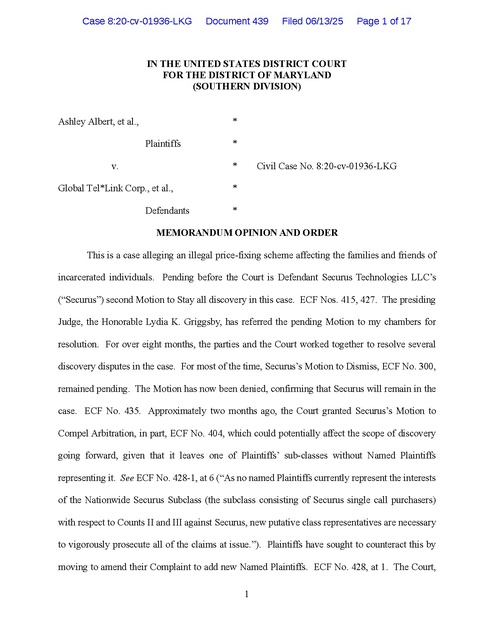
MEMORANDUM OPINION AND ORDER
This is a case alleging an illegal price-fixing scheme affecting the families and friends of
incarcerated individuals. Pending before the Court is Defendant Securus Technologies LLC’s
(“Securus”) second Motion to Stay all discovery in this case. ECF Nos. 415, 427. The presiding
Judge, the Honorable Lydia K. Griggsby, has referred the pending Motion to my chambers for
resolution. For over eight months, the parties and the Court worked together to resolve several
discovery disputes in the case. For most of the time, Securus’s Motion to Dismiss, ECF No. 300,
remained pending. The Motion has now been denied, confirming that Securus will remain in the
case. ECF No. 435. Approximately two months ago, the Court granted Securus’s Motion to
Compel Arbitration, in part, ECF No. 404, which could potentially affect the scope of discovery
going forward, given that it leaves one of Plaintiffs’ sub-classes without Named Plaintiffs
representing it. See ECF No. 428-1, at 6 (“As no named Plaintiffs currently represent the interests
of the Nationwide Securus Subclass (the subclass consisting of Securus single call purchasers)
with respect to Counts II and III against Securus, new putative class representatives are necessary
to vigorously prosecute all of the claims at issue.”). Plaintiffs have sought to counteract this by
moving to amend their Complaint to add new Named Plaintiffs. ECF No. 428, at 1. The Court,
1

Case 8:20-cv-01936-LKG

Document 439

Filed 06/13/25

Page 2 of 17

however, has yet to grant Plaintiffs’ Motion to file an Amended Complaint. Accordingly, at least
some of Plaintiffs’ claims, as previously pled, lack individuals advancing them. Recognizing the
parties’ extensive work on discovery, the Court’s denial of Securus’s Motion to Dismiss, and the
Court’s Order granting Securus’s Motion to Compel Arbitration, in part, the Court will allow
discovery to proceed, but shall be guided by the scope of the Complaint, as currently pled. In the
event that the Court grants the Motion to Amend, the undersigned will adjust the scope of discovery
accordingly. For the foregoing reasons and the reasons discussed below, Defendant Securus’s
Motion to Stay shall be granted, in part, and denied, in part.
BACKGROUND
Plaintiffs Ashley Albert, Ashley Baxter, Karina Jakeway, and Melinda Jabbie (collectively,
“Plaintiffs”) initially brought this action against Defendants Global Tel*Link Corp. (“GTL”),
Securus, and 3Cinteractive Corp. (“3CI”) on behalf of themselves, a nationwide class and three
nationwide subclasses on June 29, 2020. ECF No. 1, at 1. “This putative class action matter
involves an alleged price-fixing and kickback scheme to inflate the prices of single call collect
calls placed by [incarcerated individuals] from correctional facilities located within the United
States among defendants [GTL, Securus, and 3Ci] (collectively, “Defendants”), in violation of the
Sherman Antitrust Act and the Racketeer Influenced and Corrupt Organizations Act (“RICO
Act”).” ECF No. 122, at 1.
On September 30, 2021, the Court issued a Memorandum Opinion and Order granting-inpart and denying-in-part Defendants’ motion to dismiss and dismissing Plaintiffs’ RICO Act
claims. ECF No. 96. On May 25, 2023, the United States Court of Appeals for the Fourth Circuit
vacated the dismissal of Plaintiffs’ RICO Act claims, finding that that they had sufficiently pled
the proximate cause element of these claims. ECF No. 140-1, at 3. On February 23, 2024, Named

2

Case 8:20-cv-01936-LKG

Document 439

Filed 06/13/25

Page 3 of 17

Plaintiffs Melinda Jabbie and Karina Jakeway voluntarily dismissed their claims against all
Defendants without prejudice. ECF No. 193.
On March 29, 2024, Securus submitted a Notice of Intent to File a Motion to Stay
Discovery in the case. ECF No. 200. In support they argued: “Securus propose[s] staying all
discovery pending resolution of the motion to amend and any responsive motions, to ensure that
the scope of the claims and defenses in this litigation is set and to avoid repetitive discovery
negotiations and requests.” Id. at 1-2. See also id. at 3 (“Plaintiffs’ operative complaint is presently
a moving target that will not be resolved until any motions to dismiss the proposed amended
complaint have been resolved.”).

In their subsequent Motion to Stay, Defendant Securus

additionally emphasized that a stay was appropriate in light of that fact that although the case was
nearly four years old, discovery was still in the nascent stages. ECF No. 214, at 4. The operative
Scheduling Order did not set discovery to close until June 16, 2027, recognizing the complexity
of the case and the lack of progress the parties had made towards discovery at that time. Id. See
also ECF No. 166, at 3. Further, Securus repeatedly highlighted the need for a stay, given that
Plaintiffs had already agreed to stay multiple other parts of discovery including “depositions, class
certification briefing and discovery concerning ABRY and Platinum pending resolution of a
motion to dismiss the proposed amended complaint.” ECF No. 214 at 9; id. at 7 (“This is
particularly so in light of the uncertainty of the scope of this litigation, the fact that all New
Defendants named in either Amended Complaint will file motions to dismiss, and the expansion
of discovery that would have to occur with respect to the New Defendants if any remain in this
case.”); id. at 11 (“It makes little sense to spend months conducting this incredibly expansive
discovery as to one set of defendants, only to have to do it again if the New Defendants remain in
this case.”); id. at 12 (“Plaintiffs’ inclusion of additional members of their alleged conspiracies

3

Case 8:20-cv-01936-LKG

Document 439

Filed 06/13/25

Page 4 of 17

should, if they are pursuing their claims in good faith, require the same discovery Plaintiffs seek
from the other Defendants in this matter.”). Finally, Securus highlighted the additional difficulty
in proceeding with discovery given uncertainty as to the operative complaint and, relatedly, which
parties would remain in the case. See id. at 3-4.
On August 7, 2024, the Court held a Status Conference in the case addressing several
pending Motions, including Securus’s then-pending initial Motion to Stay. ECF Nos. 255, 260.
During the Conference, Securus reemphasized several points from its filings, namely that: 1)
before allowing any discovery, the Court should address Securus’s Motion to Compel Arbitration
because it would resolve all claims against Securus, ECF No. 260, at 10-11; and 2) allowing
discovery regarding only Securus while staying discovery regarding the other Defendants would
be inefficient, id. at 39.

In response, Plaintiffs emphasized: 1) in contrast with Securus’s

arguments, Securus’s Motion to Compel Arbitration would not resolve all claims against them,
given that two of the Named Plaintiffs would continue to have RICO and antitrust claims against
Securus, id. at 47, 53, 55; and 2) given the age of the case, a stay would further prejudice Plaintiffs,
id. at 49. After hearing argument from both parties, the Court granted Securus’s Motion, in part,
staying discovery until October, which would allow the other Defendants that had not yet answered
or moved to dismiss to file their respective pleadings or motions. Id. at 74. At that point, the Court
would reassess whether a stay of discovery was appropriate in light of the prejudice a continued
stay would have on Plaintiffs. Id. at 74-75. This would hopefully limit the possibility of piecemeal
litigation, with different parts of the case proceeding on different tracks. See, e.g., id. at 82 (“I
don’t want this case to continue like we are now on multiple tracks. That’s exactly what we’ve
been spending the last two hours talking about to try to avoid that.”); id. at 83 (“The Court would

4

Case 8:20-cv-01936-LKG

Document 439

Filed 06/13/25

Page 5 of 17

be a lot more comfortable setting the schedule going forward for discovery with everyone in the
same place, given how our discovery schedule is currently set, which is very complicated.”).
Counteracting this concern, the Court also recognized the reality that if it lifted the stay in
October, it did not want the parties to only begin to resolve any discovery disputes at that time.
See id. at 76 (“While discovery is stayed, I would hope we could make some progress on trying to
resolve [Plaintiffs’ discovery dispute].”). Accordingly, it sought the parties’ position on referral to
a United States Magistrate Judge for the resolution of Plaintiffs’ forthcoming Motion to Compel
regarding a broad range of discovery issues. Id. The Plaintiffs agreed a referral would be
appropriate, while Securus disagreed, explaining:
Your Honor, we think that any deferral to a magistrate is premature.
I don’t want to belabor the point. We’re focused on the motion to
compel arbitration. At this point, we think that discovery can be
taken up with some of those issues after the stay of discovery expires
and after the motion for arbitration has been resolved.
Id. at 77. The Court resolved the impasse by referring the case to the undersigned’s chambers for
the resolution of any discovery disputes, but cautioning that Securus would not necessarily be
required to immediately produce discovery. Id. at 79. See also id. at 86 (“When you go the
magistrate, Securus can make whatever arguments it wishes to make about the timing and how
things should proceed, but I will say from the Court’s perspective, I don’t consider that matter
stayed in the scope of my order to stay discovery until September 30, 2024.”). In support of this
approach, the Court emphasized the likelihood that any decision on Securus’s Motion to Compel
would likely not resolve all claims against Securus. See id. at 79 (“I haven’t resolved the motion,
but it’s probably not going to put us in a place where there would be no claims against Securus in
the case[.]”); id. at 80-81 (“I was originally going to agree with your recommendation, but in
looking back at, at least what the Court understands the motion to compel to be about and looking
5

Case 8:20-cv-01936-LKG

Document 439

Filed 06/13/25

Page 6 of 17

at the complaint and our conversation today, I’m not sure, even if I agree with Securus, it’s going
to resolve all the claims in the case.”). Further, as it initially emphasized when raising the question,
the Court did not want the parties to remain in the same position that they were in while two
additional months passed. Id. at 82 (“[A]t the same time, I don’t want us to be back here in
September in the same posture that we are now.”). As the Court ordered, the case was referred to
my chambers for resolution of the issues to be raised in Plaintiffs’ Motion to Compel. ECF No.
256. 1
Beginning with a Discovery Conference on September 9, 2024, the undersigned has held
six separate Discovery Conferences to resolve Plaintiffs’ Motion to Compel. ECF Nos. 275, 284,
350, 359, 367, 392. In several instances, the discovery conferences lasted multiple hours. At the
close of all but the first conference, the undersigned issued orders directing Defendants to produce
certain information. ECF Nos. 282, 357, 362, 371, 393. Where Securus contended discovery
would be unduly burdensome and the information in the record is unclear, the Court, rather than
immediately ordering production of all information sought, ordered Securus to gather additional
information regarding the burden associated with the information Plaintiffs requested. See, e.g.,
ECF No. 357, at 2 (“In preparation for a subsequent Discovery Conference, [Securus shall] confer
regarding the specific burden associated with producing the telephone numbers associated with
the structured data produced”); ECF No. 362, at 1 (“[Securus shall] [c]onduct a search of David
Abel’s electronic communications through December 31, 2020 to determine the amount of
communications available, using search terms narrower than the terms applicable to the other
custodians”); ECF No. 371, at 3 (“[Securus] [s]hall identify the number of Sales and Account

1

Separately, after the Conference, the Court denied Securus’s Motion to Strike Plaintiffs’ Amended
Complaint. ECF No. 257.
6

Case 8:20-cv-01936-LKG

Document 439

Filed 06/13/25

Page 7 of 17

Managers, Senior Revenue Accountants, Directors of Billing Operations, Managers of Revenue
Accounting, and Managers of Financial Engineering from between 2010 and 2020 for which it has
biographies in its possession, custody, or control.”).
Although the undersigned, with the parties’ assistance, has been able to resolve the majority
of discovery issues between the parties, two issues remain outstanding: 1) the scope of electronic
communications Securus must produce, including the search terms Securus must use when
selecting communications for production, see ECF No. 393 at 2, ECF No. 420; and 2) the
timeframe applicable to Plaintiffs’ third-party subpoenas requesting information regarding class
members’ purchases of calls, see ECF Nos. 384, 403. As to the first issue, although the undersigned
has yet to decide the issue, the parties have been working with the Court to resolve the issue for
several months after Plaintiffs initially raised the issue in their Motion to Compel on October 9,
2024. See ECF No. 306, at 83. During the most recent discovery conference, the Court set out a
detailed schedule and procedure for resolving this particular dispute. See ECF No. 393, at 2. 2 This

2

Specifically, the Court:
set[] out the following schedule for the resolution of the parties’ ongoing disagreement regarding the production of electronic mail
communications. On or before March 10, 2025, Defendant shall
provide Plaintiffs an updated hit report in response to Plaintiffs’
most recent proposed list of search terms. On or before March 17,
2025, the parties shall meet and confer as to whether they can reach
agreement on the remaining terms in dispute. On or before March
24, 2025, the parties shall provide a Joint Status Report to the Court
identifying the list of terms that remain in dispute, as well as
attachment(s) identifying the hit reports for the terms on which the
parties have agreed and not agreed. The Court does not anticipate
the need for a presentation of the parties’ position therein, but will
set a separate schedule, if necessary, for expedited briefing regarding
the terms remaining in dispute.

ECF No. 393 at 2.
7

Case 8:20-cv-01936-LKG

Document 439

Filed 06/13/25

Page 8 of 17

came after the Court had previously ordered Securus to produce hit counts associated with a subset
of the searches Plaintiffs had requested. See ECF No. 371, at 1 (“[Securus] [s]hall provide
Plaintiffs hit counts for each of the custodians the Court ordered in its December 27, 2024 Order
or the parties have agreed upon, using the approximately fifty search terms on which the parties
are in agreement.”).
Additionally, although the Court had previously ordered, ECF No. 371, at 3, and
Defendants were prepared to produce the “biographies” of less than 100 employees, ECF No. 382,
at 1, it paused production just a few days before the agreed upon date of production after the Court
issued its decision granting Securus’s Motion to Compel Arbitration, in part. ECF No. 415. The
Court originally ordered Securus to produce these biographies on or before March 21, 2025, ECF
No. 371, at 1, but the parties jointly agreed that Securus could produce the “biographies” on or
before April 7, 2025, ECF No. 382, at 1. See also ECF No. 394, at 8 (“overall, you have it correct,
we’re going to produce it [within thirty days after] March 7th. I don’t think we need any further
guidance. I think the additional two weeks provided what we needed.”). As Securus conceded,
many of the “biographies” were just resumes they had gathered. See id. (“We gathered up these
biographies . . . – really, they were sort of resumes that went into pitch documents, as opposed to
just biographies, except for the non-execs who were able to gather those up, and we'll produce
them [within thirty days after] March 7th.”).
On March 27, 2025, the Court granted, in part, and denied, in part, Securus’s Motion to
Compel Arbitration, staying Plaintiffs Ashley Albert’s and Ashley Baxter’s claims against Securus,
pending the completion of the parties’ arbitration proceedings. ECF No. 404. In response, on
April 11, 2025, Plaintiffs filed a Notice of Intent to file an Amended Complaint, stating that they

8

Case 8:20-cv-01936-LKG

Document 439

Filed 06/13/25

Page 9 of 17

intend to “substitute[] new named plaintiffs in the place of Plaintiffs Albert and Baxter to represent
the class in connection with its claims against Securus.” ECF No. 416, at 2.
The parties have since filed several papers addressing the appropriateness of a stay of
discovery – many of which make similar points. See, e.g., ECF Nos. 415, 417, 419, 420, 424, 425,
427, 429. Defendants generally believe all discovery should be stayed pending the Court’s
decision on its Motion to Dismiss and Plaintiffs’ Motion to file an Amended Complaint, because
“[t]he Court [c]ompelled [a]rbitration and [s]tayed the [c]laims of the [o]nly Named Plaintiffs
[w]ho [d]irectly [p]urchased Securus’s [p]roducts.” ECF No. 415, at 2. See also ECF No. 419, at
2 (“Securus respectfully requests that the Court stay all discovery against Securus until the Court
resolves Securus’s pending motion to dismiss, Plaintiffs’ belated motion for a second amendment
to their complaint, and any response to that second amended complaint, if leave to file the
complaint is granted.”); id. at 3 (“[T]here are no direct purchasers of Securus’[s] class products
asserting claims against Securus. Plaintiffs’ filing reveals a central, disruptive truth regarding the
course of this putative class action: no plaintiff can proceed with their claims against Securus on a
class basis, regardless of who they are suing, unless it is first determined whether they agreed to
arbitrate their claims on an individual basis.”); ECF No. 427, at 3 (“Plaintiffs gloss over the fact
that they now have no direct purchaser plaintiffs to represent their claims in this litigation”); id. at
6 (“[I]n the nearly five years since this litigation commenced, Plaintiffs have failed to name any
plaintiff who can represent Plaintiffs’ claims as direct purchasers against Securus.”). As a result,
according to Securus, “absent a stay, Securus will be forced to submit discovery and commit
resources to discovery disputes on claims that have been compelled to arbitration and stayed
pending the outcome of that arbitration.” ECF No. 415, at 6. Relatedly, Securus also argues, as it
previously did in support of its first Motion to Stay, that discovery should not proceed until the

9

Case 8:20-cv-01936-LKG

Document 439

Filed 06/13/25

Page 10 of 17

pleadings are set. See ECF No. 424, at 1 (“[D]iscovery in this matter should be stayed. Plaintiffs’
recent filings confirm that, in Plaintiffs’ view, the pleadings are not yet set.”).
Meanwhile, Plaintiffs argue that discovery should proceed as it did before, given their plans
to substitute new Named Plaintiffs who are not subject to the arbitration arguments applicable to
former Named Plaintiffs Albert and Baxter. See ECF No. 417, at 2 (“Plaintiffs have filed a request
to substitute as named plaintiffs purchasers of Securus single calls who are not subject to
arbitration provisions and will thus be able to represent class members even with respect to the
minority of RICO claims that Securus claims were impacted by the Court’s arbitration ruling.”).
Additionally, Plaintiffs note that even if they do not currently have Plaintiffs who directly
purchased products from Securus, they will, nonetheless, be able to pursue claims against the
corporation. See id. (“Plaintiffs Rhonda Howard and Lupei Zhu continue to have both RICO and
antitrust claims against Securus.”). Along these lines, Plaintiffs allege that all of the discovery
previously sought is relevant to the claims that remain. ECF No. 425, at 5.
On June 11, 2025, the Court denied Securus’s Motion to Dismiss, substantially
undercutting many of the arguments Securus had relied upon in its second request to stay all
discovery. See ECF No. 435. Importantly, the Court found that: 1) Plaintiffs plausibly allege a
Sherman Act claim against Securus, id. at 20; and 2) Plaintiffs plausibly allege RICO Act claims
against Securus, id. at 22. Importantly, as part of the second finding, the Court explicitly rejected
the argument that: “the Plaintiffs in this case who only purchased GTL products are unable to
pursue their RICO conspiracy claims against Securus.” Id. at 24.
LEGAL STANDARD
Federal Rule of Civil Procedure 26(c) vests the district court with broad discretion to stay
discovery if the moving party can demonstrate “good cause”. Wymes v. Lustbader, No. 10-cv-

10

Case 8:20-cv-01936-LKG

Document 439

Filed 06/13/25

Page 11 of 17

1629, 2012 WL 1819836, at *3-*4 (D. Md. May 16, 2012). To meet this standard, it is not
sufficient for a party to simply provide a reason; “Rule 26(c)’s good cause requirement ‘creates a
rather high hurdle’ for the moving party.” Id. at *4 (quoting Baron Fin. Corp. v. Natanzon, 240
F.R.D. 200, 202 (D. Md. 2006)). However, once this standard is met, “[t]he Rule ‘confers broad
discretion on the trial court to decide when a protective order is appropriate and what degree of
protection is required.’” Furlow v. United States, 55 F. Supp. 2d 360, 366 (D. Md.1999) (quoting
Seattle Times Co. v. Rhinehart, 467 U.S. 20, 36 (1984)).
ANALYSIS
Although the parties have extensively briefed the appropriateness of a stay, both sets of
briefing suffer from the same limitation: they ask the undersigned to adopt their position based on
an assumption that the Court will take a position it has not adopted. Securus asks the undersigned
to halt all discovery based largely on the mistaken belief that the Court would grant their Motion
to Dismiss. Plaintiffs, in turn, ask that the Court permit discovery to proceed just as it would have
before the Court granted Securus’s Motion to Compel Arbitration because they have sought leave
to add new Named Plaintiffs not subject to Securus’s arbitration arguments. As the Court has not
granted Plaintiffs’ Motion to Amend, and has denied Securus’s Motion to Dismiss, the Court will
only grant Securus’s Motion to Stay, in part. Discovery will proceed in the case, but based on the
scope of the case as defined in the present version of the Complaint. If, as Plaintiffs allege, all
discovery remains relevant under the present version of the Complaint, the Court shall consider
any differences between the present version and the proposed version of the Complaint when
balancing the relevance of the information sought and the burden its production would impose on
Securus. Once the Court grants or denies Plaintiffs’ Motion to Amend, the undersigned shall adjust
the scope of discovery as necessary.

11

Case 8:20-cv-01936-LKG

I.

Document 439

Filed 06/13/25

Page 12 of 17

Defendant Has Not Established Good Cause to Stay Discovery Completely.
To show good cause, the moving party “may not rely upon ‘stereotyped and conclusory

statements’”; rather, the party “must present a ‘particular and specific demonstration of fact’ as to
why a protective order [staying discovery] should issue.” Natanzon, 240 F.R.D. at 202 (quoting
8A Wright & Miller’s Federal Practice & Procedure § 2035 (2d. ed. 1994). “Broad allegations of
harm, unsubstantiated by specific examples or articulated reasoning, do not support a good cause
showing.” Id. (quoting Merit Indus., Inc. v. Feuer, 201 F.R.D. 382, 384–85 (E.D. Pa. 2001)). In
the context of a request to stay discovery, “[t]he moving party must come forward with a specific
factual showing that the interest of justice and considerations of prejudice and undue burden to the
parties require a protective order and that the benefits of a stay outweigh the cost of delay.” Kron
Med. Corp. v. Groth, 119 F.R.D. 636, 638 (M.D.N.C. 1988).
In denying Securus’s Motion to Dismiss, the Court rejected Defendant’s primary argument
that discovery should be stayed in light of the fact that, as currently pled, Plaintiffs’ present
Complaint does not include any individuals who directly purchased products from Securus.
Additionally, Securus’s arguments are further undercut by the resources the undersigned
and the parties have committed to discovery. Since the Court referred the case for discovery, the
parties and the Court have devoted six separate, multiple-hour conferences to resolving the
discovery disputes, addressing, on multiple occasions, two of the three remaining issues. As to the
first issue – the scope of electronic communications, the Court has issued multiple Orders and set
a detailed schedule for the exchange of search terms and hit reports and participation in meet and
confers to resolve the issue. Additionally, as to the second issue – the 100 biographies, the Court,
after hearing argument from both parties, has already determined that production is appropriate,
and Securus has already gathered the information to be produced. Accordingly, the parties, as well

12

Case 8:20-cv-01936-LKG

Document 439

Filed 06/13/25

Page 13 of 17

as this Court, have already devoted much of the resources that Securus argues would be saved
were discovery stayed.
Finally, as this Court has cautioned, arguments regarding the burden of discovery are
generally not a basis to pause all discovery:
The [Defendant’s] claims that discovery requests will improperly
burden [it], and that discovery disputes will impact judicial
economy, are premature. The Court will consider and resolve
discovery disputes, if any, as they arise, with due regard to all
arguments offered by the parties and consideration of the interests
of the parties and the need for judicial economy.
Int’l Refugee Assistance Project v. Trump, 404 F. Supp. 3d 946, 953 (D. Md. 2019).
While Securus’s request that the Court limit discovery until the pleadings are set is
somewhat more persuasive, it does not justify a complete stay of all discovery. As Plaintiffs note
in their Opposition, two of the remaining Named Plaintiffs maintain claims against Securus. ECF
No. 417, at 2. Further, as the Court concluded in denying Securus’s Motion to Dismiss, Plaintiffs
are able to pursue claims against Securus even if the Plaintiffs did not purchase products directly
from it. ECF No. 435, at 24. See also Seeds of Peace Collective v. City of Pittsburgh, No. 09-cv1275, 2010 WL 2990734, at *1 (W.D. Pa. July 28, 2010) (concluding that “the need to protect
these defendants from the burdens of litigation [is] not present” and denying motion to stay
discovery because the defendants would remain as fact witnesses for claims not subject to appeal).
Finally, the Court explicitly rejected these same arguments when referring this case for resolution
of Plaintiffs’ Motion to Compel Discovery. Accordingly, these arguments, at most, establish good
cause to limit discovery, for the time being, to the claims as they are presently defined. 3
II.

A Complete Stay Would Prejudice Plaintiffs and Waste Judicial Resources.

3

Whether that means actually denying discovery as to certain categories of information or limiting
the scope of discovery will depend on the contours of the individual dispute.
13

Case 8:20-cv-01936-LKG

Document 439

Filed 06/13/25

Page 14 of 17

Once a moving party has shown good cause, the Court’s inquiry is not complete. A court
must “weigh competing interests and maintain an even balance.” Landis v. N. Am. Co., 299 U.S.
248, 255 (1936). See also United States v. Ga. Pac. Corp., 562 F.2d 294, 296 (4th Cir. 1977) (“The
determination by a district judge in granting or denying a motion to stay proceedings calls for an
exercise of judgment to balance the various factors relevant to the expeditious and comprehensive
disposition of the causes of action on the court’s docket.”). In particular, the Court must consider
“the length of the requested stay, the hardship that . . . the movant would face if the motion were
denied, the burden a stay would impose on the nonmovant, and whether the stay would promote
judicial economy by avoiding duplicative litigation.” In re Mut. Funds Litigation, No. 04-cv-1274,
2011 WL 3819608, at *1 (D. Md. Aug. 25, 2011). See also Tawwaab v. Va. Linen Serv., Inc., 729
F. Supp. 2d 757, 768–69 (D. Md. 2010) (noting that courts generally weigh “the danger of prejudice
to the non-moving party, the length of delay and its potential impact on judicial proceedings, the
reason for the delay, and whether the movant acted in good faith.”) (internal quotation marks and
citation omitted).
“In order to issue a stay, a court must be satisfied that a ‘pressing need’ exists, and that ‘the
need for a stay outweighs any possible harm to the nonmovant.’” Hunt Valley Baptist Church, Inc.
v. Baltimore County, Maryland, No. 17-cv-804, 2018 WL 1570256, at *2 (D. Md. Mar. 29, 2018)
(quoting Elite Const. Team, Inc. v. Wal-Mart Stores, Inc., No. 14-cv-2358, 2015 WL 925927, at *3
(D. Md. Mar. 2, 2015)). A court should generally deny a stay of discovery “if discovery is needed
in defense of the motion, or if resolution of the motion will not dispose of the entire case.”
Natanzon, 240 F.R.D. at 203 (internal quotation marks and citations omitted).
The reason for disfavoring such relief is relatively straight forward. “Several courts have
cautioned against staying discovery, noting that motions to stay discovery are ‘not favored because

14

Case 8:20-cv-01936-LKG

Document 439

Filed 06/13/25

Page 15 of 17

when discovery is delayed or prolonged it can create case management problems which impede
the Court’s responsibility to expedite discovery and cause unnecessary litigation expenses and
problems.’” Wymes, 2012 WL 1819836, at *4 (quoting Simpson v. Specialty Retail Concepts, Inc.,
121 F.R.D. 261, 263 (M.D.N.C. 1988)). In considering motions to stay discovery:
[T]he Court needs to remain mindful of its responsibility to expedite
discovery and minimize delay. . . . Disruption or prolongation of the
discovery schedule is normally in no one’s interest. A stay of
discovery duplicates costs because counsel must reacquaint
themselves with the case once the stay is lifted. Matters of
importance may be mislaid or avenues unexplored. A case becomes
more of a management problem to the Court when it leaves the
normal track. While time may heal some disputes, in others it
merely permits more opportunity for festering.
Groth, 119 F.R.D. at 637-38 (internal citation omitted). See also Medlin v. Andrew, 113 F.R.D.
650, 652 (M.D.N.C. 1987) (stating that protective orders “should be sparingly used and cautiously
granted”); Cognate BioServices, Inc. v. Smith, No. 13-cv-1797, 2015 WL 5673067, at *2 (D. Md.
Sep. 23, 2015) (“[D]iscovery stays can result in case management problems, a prolongation of the
proceedings, and a duplication of the costs of counsel. . . . For these reasons, the Court must
carefully weigh the potential costs and benefits of a stay of discovery.”) (internal citation omitted).
Accordingly, “while staying discovery may preserve resources, more often, it [has] the reverse
effect.” Ario Minerals, LLC v. Diversified Production, LLC, No. 23-cv-00522, 2024 WL 3488075,
at *1 (S.D. W.Va. Jul. 19, 2024).
Even had Securus established good cause for staying all discovery in the case, any such
cause would be outweighed by the Plaintiffs’ and the Court’s interest in the prompt resolution of
the case. As the Court explained when referring this case to the undersigned, given the long
running nature of the case, it was in the parties’, as well as the Court’s, interest to resolve the
discovery disputes between the parties as soon as practically possible. Further, as noted above,
15

Case 8:20-cv-01936-LKG

Document 439

Filed 06/13/25

Page 16 of 17

both the parties as well as the Court have devoted significant time to resolving these disputes.
These efforts would be put to waste were Securus now excused from participating in all discovery
in the case. This is particularly the case regarding 1) the categories of discovery which the Court
has already taken the time to resolve, i.e., the 100 biographies; and 2) the categories of information
that the parties have already, pursuant to the Court’s Orders, begun work towards resolving, i.e.,
the scope of electronic communications Securus must produce. See Cognate BioServices, Inc.,
2015 WL 5673067, at *6 (ordering a partial stay of discovery not including “any discovery
between Cognate and the Smith Defendants that the parties have previously agreed to conduct”).
The applicable timeframe for Plaintiffs’ subpoenas to third parties presents a closer
question. As with the two other points of dispute, Plaintiffs maintain an interest in prompt
resolution of this issue. However, while the parties have devoted some resources to resolving this
issue, their work on it has been less extensive; nor has the Court devoted time to resolving this
issue beyond setting a briefing schedule. See ECF No. 403. Complicating matters, while Plaintiffs
have maintained that all discovery, including that related to this issue, is relevant to the case as
currently pled, Defendants have not addressed the impact of the Arbitration Opinion, beyond
arguing that all discovery should be stayed. Accordingly, there is some ambiguity as to what extent
staying resolution of this issue would, in fact, reserve Securus’s resources.
Recognizing these competing interests, the Court orders Securus to produce, within seven
days, the biographies the Court had previously ordered, and Securus had agreed to produce.
Regarding the two remaining categories – electronic communications and third-party subpoenas –
the Court will schedule an additional discovery conference to determine what, if any, portions of
the discovery sought are relevant and not unduly burdensome under the Complaint, as currently

16

Case 8:20-cv-01936-LKG

Document 439

Filed 06/13/25

Page 17 of 17

pled. The Court does not expect to hold additional discovery conferences to address these issues
unless there is a change in circumstances necessitating the Court reassess the scope of discovery.
CONCLUSION
For the foregoing reasons, Defendant Securus’s Motion to Stay Discovery, ECF Nos. 415
and 427, is granted, in part, and denied, in part. The Court shall schedule a discovery conference
to determine the precise scope of relevant, non-burdensome discovery, under the Complaint, as
currently pled.
So ordered.
Date: June 13, 2025

______/s/________________
Ajmel A. Quereshi
U.S. Magistrate Judge

17