

Albert v. Global Tel Link Corp, MD, Opinion, Telephone Rates, 2025
Download original document:
Document text
Document text
This text is machine-read, and may contain errors. Check the original document to verify accuracy.
Case 8:20-cv-01936-LKG

Document 435

Filed 06/11/25

Page 1 of 26

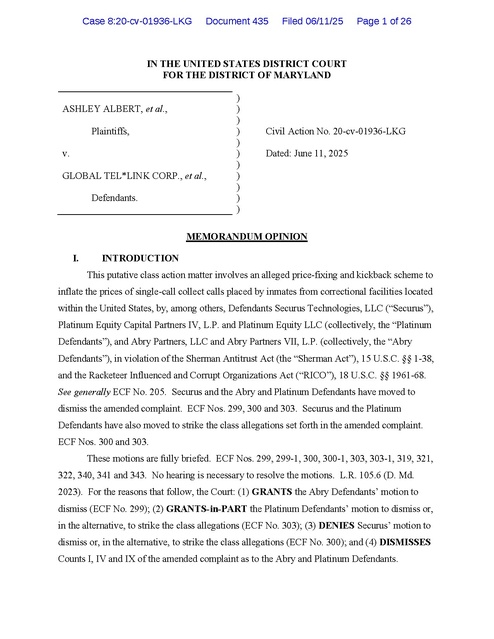
IN THE UNITED STATES DISTRICT COURT
FOR THE DISTRICT OF MARYLAND
ASHLEY ALBERT, et al.,
Plaintiffs,
v.
GLOBAL TEL*LINK CORP., et al.,
Defendants.

)
)
)
)
)
)
)
)
)
)
)

Civil Action No. 20-cv-01936-LKG
Dated: June 11, 2025

MEMORANDUM OPINION
I.

INTRODUCTION
This putative class action matter involves an alleged price-fixing and kickback scheme to

inflate the prices of single-call collect calls placed by inmates from correctional facilities located
within the United States, by, among others, Defendants Securus Technologies, LLC (“Securus”),
Platinum Equity Capital Partners IV, L.P. and Platinum Equity LLC (collectively, the “Platinum
Defendants”), and Abry Partners, LLC and Abry Partners VII, L.P. (collectively, the “Abry
Defendants”), in violation of the Sherman Antitrust Act (the “Sherman Act”), 15 U.S.C. §§ 1-38,
and the Racketeer Influenced and Corrupt Organizations Act (“RICO”), 18 U.S.C. §§ 1961-68.
See generally ECF No. 205. Securus and the Abry and Platinum Defendants have moved to
dismiss the amended complaint. ECF Nos. 299, 300 and 303. Securus and the Platinum
Defendants have also moved to strike the class allegations set forth in the amended complaint.
ECF Nos. 300 and 303.
These motions are fully briefed. ECF Nos. 299, 299-1, 300, 300-1, 303, 303-1, 319, 321,
322, 340, 341 and 343. No hearing is necessary to resolve the motions. L.R. 105.6 (D. Md.
2023). For the reasons that follow, the Court: (1) GRANTS the Abry Defendants’ motion to
dismiss (ECF No. 299); (2) GRANTS-in-PART the Platinum Defendants’ motion to dismiss or,
in the alternative, to strike the class allegations (ECF No. 303); (3) DENIES Securus’ motion to
dismiss or, in the alternative, to strike the class allegations (ECF No. 300); and (4) DISMISSES
Counts I, IV and IX of the amended complaint as to the Abry and Platinum Defendants.

Case 8:20-cv-01936-LKG

II.

Document 435

Filed 06/11/25

Page 2 of 26

FACTUAL AND PROCEDURAL BACKGROUND 1
A. Factual Background
In this putative class action, the Plaintiffs allege that the Defendants engaged in a price-

fixing and kickback scheme to inflate the prices of single-call collect calls placed by inmates
from correctional facilities located within the United States. See generally ECF No. 205. In the
amended complaint, the Plaintiffs assert the following nine claims against the Defendants: (1)
Conspiracy to fix prices in violation of Section 1 of the Sherman Act against all Defendants
(Count I); (2) Violation of RICO against Securus (Count II); (3) Violation of RICO against
Securus and Defendant 3CInteractive Corp. (“3CI”) (Count III); (4) Violation of RICO against
the Abry and Platinum Defendants (Count IV); (5) Violation of RICO against Defendant Global
Tel*Link Corp. (“GTL”) (Count V); (6) Violation of RICO against GTL and C3I (Count VI); (7)
Conspiracy to violate RICO against Securus and GTL (Count VII); (8) Conspiracy to violate
RICO against Securus, GTL and C3I (Count VIII); and (9) Conspiracy to violate RICO against
the Abry Defendants, the Platinum Defendants, Securus and GTL (Count IX). ECF No. 205 at
¶¶ 251-434.
Specifically, the Plaintiffs allege that the Defendants committed a per se violation of the
Sherman Act, by conspiring to: (1) eliminate competition between themselves; (2) fix and charge
inflated prices for their single-call products; and (3) pay low site commission fees for their
single-call products. See ECF No. 205 at ¶¶ 251-256. The Plaintiffs also allege that the
Defendants violated RICO by making fraudulent misrepresentations and omissions to certain
contracting governments, and to consumers, for the purposes of charging excessive rates and
paying low site commission fees for their single-call products. See id. at ¶¶ 257-434. And so,
the Plaintiffs seek, among other things, to recover monetary damages, attorney’s fees and costs
from the Defendants. Id. at Prayer for Relief.
The Parties
Plaintiff Ashley Albert is a resident of the State of New Hampshire who paid $14.99 to
accept a PayNow single call that was sold by Securus. Id. at ¶ 26.

The facts recited herein are taken from the amended complaint. ECF No. 205. Unless otherwise stated,
the facts are undisputed.

1

2

Case 8:20-cv-01936-LKG

Document 435

Filed 06/11/25

Page 3 of 26

Plaintiff Ashley Baxter is a resident of the State of Oregon who paid $14.99 to accept a
PayNow single call that was sold by Securus. Id. at ¶ 27. 2
Plaintiff Lupei Zhu is a resident of the State of Missouri who paid $9.99 to accept a
Collect2Phone single call that was sold by GTL. Id. at ¶ 28.
Plaintiff Rhonda Howard is a resident of the State of California who paid $14.99 to
accept a Collect2Phone single call that was sold by GTL. Id. at ¶ 29.
Defendant GTL is an Idaho corporation, with its principal place of business located in
Falls Church, Virginia, that provides inmate calling services (“ICS”) to approximately 2,300
correctional facilities. Id. at ¶ 30.
Defendant Securus is a privately held Delaware corporation, with its principal place of
business located in Carrollton, Texas, that provides ICS to approximately 3,400 correctional
facilities. Id. at ¶ 32.
Defendant Platinum Equity Capital Partners IV, L.P. is a privately held Delaware
corporation, with its principal place of business located in Beverly Hills, California, and it is the
majority owner of Securus. Id. at ¶ 34.
Defendant Platinum Equity, LLC is a privately held Delaware corporation, with its
principal place of business located in Beverly Hills, California, and it controls and manages
Platinum Equity Capital Partners IV, L.P. Id.
Defendant Abry Partners VII, L.P. is a privately held Delaware corporation, with its
principal place of business located in Boston, Massachusetts, and it was the majority owner of
Securus from April 2013 to April 2017. Id. at ¶ 35.
Defendant Abry Partners, LLC is a privately held Delaware corporation, with its principal
place of business located in Boston, Massachusetts, and it controls and manages Abry Partners
VII, L.P. Id. at ¶ 36.
Defendant 3CI is a Delaware company, with its principal place of business located in
Boca Raton, Florida, and it is a mobile marketing company and payment processor. Id. at ¶ 37.

On April 1, 2025, the Court entered a Memorandum Opinion and Order that granted Securus’ motion to
compel arbitration as to Plaintiffs Ashley Albert and Ashley Baxter, and stayed these Plaintiffs’ claims
against Securus, pending the completion of the parties’ arbitration proceedings. ECF No. 408 at 18.

2

3

Case 8:20-cv-01936-LKG

Document 435

Filed 06/11/25

Page 4 of 26

The ICS Contracts
As background, the providers of inmate calling services, or ICS, provide hundreds of
millions of calls from inmates housed in correctional facilities located throughout the United
States. Id. at ¶ 40. To facilitate these services, local and state governments enter into exclusive
contracts with ICS providers to service a particular correctional facility. Id. at ¶¶ 45-46.
The terms of these ICS contracts include both the rates that the ICS providers will charge
consumers to receive calls from inmates, as well as the “site commissions”—a percentage of the
revenue made from each call that the ICS providers must pay to the contracting governments. Id.
at ¶ 47. Because only the contracting governments can enter into ICS contracts with the ICS
providers, inmates and consumers cannot choose which ICS provider or service to use to place
their calls. Id. at ¶ 45.
Securus and GTL together service more than 80% of the ICS calls placed by inmates
throughout the United States. Id. at ¶ 54. In 2010, Securus launched two “single call” services:
(1) “PayNow,” which charges a flat fee of $14.99 to the customer’s credit card for calls lasting
up to 15 minutes, and (2) “Text2Connect,” which charges a flat fee of $9.99 to a customer’s
mobile phone account for calls lasting up to ten minutes. Id. at ¶¶ 57-60. Securus contracted
with 3CI to market, implement and operate these ICS services. Id. at ¶ 65. And so, 3CI collects
payment information from customers, processes and bills payments, and establishes and manages
the websites for the PayNow and Text2Connect services. Id. at ¶¶ 66-67.
3CI also utilizes a patented technology that charges collect calls directly to a mobile
phone account. Id. at ¶ 68. In return for operating the PayNow and Text2Connect services, 3CI
receives a “transaction fee” from Securus for each single call made via these services. Id. at ¶
69.
Securus offers the PayNow and Text2Connect services under several ICS contracts with
local and state governments. Id. at ¶ 63. Pursuant to these ICS contracts, Securus provides a site
commission to the contracting governments, in the amount of $1.60, for each PayNow call made
and in the amount of $0.30, for each Text2Connect call made. Id. at ¶ 61.
In 2010, GTL began developing a single-call service, known as “AdvancedPay OneCall”
(“APOC”), and GTL made APOC operational in 2014. Id. at ¶¶ 73 and 98. GTL markets and
offers the APOC service through its ICS contracts with the contracting governments. Id. at ¶ 98.
The APOC service charges a $3.00 transaction fee to the call recipient’s credit card, along with

4

Case 8:20-cv-01936-LKG

Document 435

Filed 06/11/25

Page 5 of 26

the applicable standard per-minute rate contained in the relevant ICS contract. Id. at ¶ 73. Like
Securus, GTL pays a site commission to the contracting governments for APOC calls. Id. at ¶
74.
Before launching its APOC single-call service, GTL launched a separate single-call
program with two single-call options operated by 3CI: (1) “Collect2Card,” which charges a flat
fee of $14.99 to the customer’s credit card for calls lasting up to 15 minutes, and (2)
“Collect2Phone,” which charges a flat fee of $9.99 to a customer’s mobile phone account for
calls lasting up to ten minutes. Id. at ¶¶ 84-87. When GTL launched the Collect2Card and
Collect2Phone single-call programs in 2013, it amended multiple existing ICS contracts with
state and local governments to add the Collect2Card and Collect2Phone options and charge
$14.99 and $9.99, respectively, for single calls. Id. at ¶ 97.
The Alleged Price-Fixing Scheme
In the amended complaint, the Plaintiffs allege that the Defendants engaged in a
horizontal price-fixing scheme, whereby Securus and GTL fixed inflated prices for ICS singlecall services and misrepresented information about the costs of these services to certain local and
state government officials, and to consumers. Id. at ¶ 1. Specifically, the Plaintiffs allege that
executives for Securus and GTL regularly and secretly communicated to eliminate competition
in the ICS market. Id. at ¶ 80. In this regard, the Plaintiffs also allege that, when GTL initially
planned to launch APOC, GTL intended to charge call recipients significantly less for single
calls than Securus charges for its PayNow and Text2Connect services. Id. at ¶¶ 73-74. But, the
Plaintiffs allege that Securus and GTL later conspired to fix the prices of their respective singlecall services, resulting in GTL ultimately charging a higher price for its Collect2Card and
Collect2Phone ICS services and the elimination of price competition for single calls. Id. at ¶¶
75-84.
In addition, the Plaintiffs contend that the groundwork for this price-fixing agreement
was laid in November 2012, when Securus purchased 3CI’s patent for the technology used to
charge mobile phone accounts for single calls. Id. at ¶ 76. In this regard, the Plaintiffs allege
that—as a condition of agreeing to purchase the patent—Securus insisted that any agreement
between 3CI and GTL to market and operate ICS calls require that GTL’s single-call program
charge the same prices as Securus charges for its single-call program. Id. at ¶ 78.

5

Case 8:20-cv-01936-LKG

Document 435

Filed 06/11/25

Page 6 of 26

The Abry And Platinum Defendants
Relevant to the pending motions, the Plaintiffs maintain in this action that Abry Partners
VII, L.P. and Platinum Equity Capital Partners IV, L.P. were Securus’ alter egos, and thus, also
participants in the alleged fraud scheme. Id. at ¶¶ 178-197. In this regard, the Plaintiffs allege
that, between April 2013 and November 2017, Abry Partners VII, L.P. controlled Securus,
because it was the majority owner of Securus. Id. at ¶ 178. The Plaintiffs also allege that Abry
Partners, LLC manages and controls Abry Partners VII, L.P. Id. at ¶ 178.
In addition, the Plaintiffs allege that—as the majority owner and controller of Securus—
the Abry Defendants: (1) siphoned funds from Securus, causing Securus to become grossly
undercapitalized; (2) ignored corporate formalities and maintained significant overlap in officers
and directors with Securus; and (3) made misrepresentations on behalf of Securus to facilitate the
sale of Securus to Platinum Equity Capital Partners IV, L.P. Id. at ¶¶ 184-197. And so, the
Plaintiffs further allege that the Abry Defendants exercised substantial strategic control over
Securus and that Abry Partners VII, L.P. acted as Securus’ alter ego during the period that it was
the majority owner of Securus. Id. at ¶¶ 178-197.
Second, the Plaintiffs allege that, beginning in November 2017, Platinum Equity Capital
Partners IV, L.P. acquired a majority equity interest and the controlling voting interest in
Securus. Id. at ¶ 198. The Plaintiffs also allege that Platinum Equity, LLC manages and controls
Platinum Equity Capital Partners IV, L.P. Id. In addition, the Plaintiffs allege that the Platinum
Defendants participated in, and encouraged Securus’ participation in, the alleged price-fixing
conspiracy. Id. at ¶¶ 199-203. In this regard, the Plaintiffs allege that Securus entered into at
least two ICS contracts for its single-call products that involved inflated prices while Platinum
Equity Capital Partners IV, L.P. was the majority owner of Securus. Id. at ¶ 202. And so, the
Plaintiffs allege that the Platinum Defendants maintained significant overlap in officers and
directors with Securus. Id. at ¶¶ 204-222.
The Plaintiffs’ Sherman Act And RICO Claims
In Count I of the amended complaint, the Plaintiffs allege that the Defendants committed
a per se violation of Section 1 the Sherman Antitrust Act, by “enter[ing] into a continuing
agreement, understanding, and conspiracy in restraint of trade to prevent and eliminate price
competition over single calls between Securus and GTL and to fix, inflate, maintain, and
stabilize the price of 3CI-operated single calls charged to consumers in the United States.” Id. at

6

Case 8:20-cv-01936-LKG

Document 435

Filed 06/11/25

Page 7 of 26

¶ 252. The Plaintiffs further allege that, as a result of this alleged scheme, the Defendants: (1)
restrained or eliminated competition in the ICS market; (2) fixed and maintained inflated prices
for single-call services and (3) deprived consumers of the benefit of true competition in the ICS
market. Id. at ¶ 255.
The Plaintiffs also allege that the Abry Defendants were involved in Securus’ fraudulent
conduct, aware of Securus’ relationship with 3CI and communicated directly with 3CI
concerning its business operations. Id. at ¶ 181. In addition, the Plaintiffs allege that the Abry
Defendants facilitated the operation of Securus when Securus entered into certain government
contracts that allowed Securus to sell PayNow and Text2Connect at fixed prices. Id. at ¶ 182.
The Plaintiffs further allege that the Platinum Defendants implemented a “ceasefire,” in which
neither Securus nor GTL would publicly criticize each other or their business practices, which
further ensured that the companies did not attack each other’s single-call prices. Id. at ¶ 200. In
addition, the Plaintiffs allege that, after acquiring Securus, the Platinum Defendants instructed
Securus to not complete the acquisition of 3CI, so that Securus could continue its
misrepresentations to governments regarding the amount of the transaction fees it paid to 3CI.
Id. at ¶ 201.
In Counts II-IX of the amended complaint, the Plaintiffs assert RICO claims against the
Defendants. Specifically, the Plaintiffs allege that the Defendants violated RICO by making
certain misrepresentations and/or omissions to the contracting governments, and to consumers,
regarding the amount of the transaction fees that Securus and GTL paid to 3CI. See id. at Counts
II-IX; see also id. at ¶¶ 267, 292, 316, 340 and 365 (alleging RICO predicate acts). 3 And so, the
Plaintiffs contend that they have been harmed in their business and property by the Defendants’
alleged fraudulent conduct. Id. at ¶¶ 279, 304, 328, 352, 377, 394, 416 and 433.
The Plaintiffs also allege that the Defendants violated RICO, by making several
misrepresentations and/or omissions to certain local and state government officials, and to
The Plaintiffs’ RICO claims are predicated upon the federal criminal mail fraud statute, 18 U.S.C. §
1341, and the federal criminal wire fraud statute, 18 U.S.C. § 1343. The Plaintiffs allege that the
Defendants committed mail fraud, by knowingly and intentionally mailing misrepresentations and/or
omissions to the contracting governments and to consumers regarding the transaction fees paid to 3CI for
operating PayNow, Text2Connect, Collect2Card and Collect2Phone calls. ECF No. 205 at ¶¶ 268, 293,
317, 341 and 366. The Plaintiffs further allege that the Defendants committed wire fraud by knowingly
and intentionally transmitting misrepresentations and/or omissions electronically to the contracting
governments and to consumers. Id. at ¶¶ 269, 294, 318, 342 and 367.

3

7

Case 8:20-cv-01936-LKG

Document 435

Filed 06/11/25

Page 8 of 26

consumers, about the magnitude of the transaction fees associated with ICS single calls operated
by 3CI. Id. at ¶¶ 3 and 18. In this regard, the Plaintiffs allege that Securus and GTL incorrectly
represented to government officials and consumers that the charges for single calls were
comprised of necessary transaction fees paid to 3CI. Id. at ¶¶ 270, 295, 343 and 368.
The Plaintiffs further allege that a former Securus executive admitted that his team would
incorrectly inform government officials that the “vast majority” of the $14.99 and $9.99 charges
collected from PayNow and Text2Connect calls were paid to 3CI to cover transaction fees. Id. at
¶ 148. In this regard, the Plaintiffs also allege that a former GTL employee explained that “both
Securus and GTL informed governments that the high price of single calls” was “a direct
consequence of sizable transaction fees that were an unavoidable part of the cost of
implementing those calls.” Id. at ¶ 151. The Plaintiffs also allege that Securus and GTL
misrepresented and/or omitted the true value of the transaction fees paid to 3CI for single calls in
their monthly commission reports to the contracting governments. Id. at ¶¶ 145 and 156-161.
The Plaintiffs allege that the public websites for Securus’ PayNow and GTL’s
Collect2Card falsely state that the $14.99 charge for single calls “is broken out as $1.80 for the
Call Fee and $13.19 for the Transaction Fee.” Id. at ¶ 162. And so, the Plaintiffs allege that
consumers have been improperly billed twice for a call and transaction fee and that the
Defendants failed to disclose the actual transaction fee paid to 3CI in the billing statements
mailed to consumers. Id. at ¶¶ 162-165.
In addition, the Plaintiffs allege that the Abry Defendants were implicated in
misrepresentations made by Securus to the FCC about Abry Partners VII, L.P.’s sale of Securus
to Platinum Equity Capital Partners IV, L.P. in 2017, for which Securus was fined $1.7 million.
Id. at ¶ 192. The Plaintiffs further allege that the Abry Defendants directed the RICO enterprise
through Securus, and directed Securus to repeatedly make material misrepresentations to
contracting governments regarding the value of the transaction fees that were associated with
PayNow and Text2Connect calls. Id. at ¶¶ 313-314. Lastly, the Plaintiffs allege that the
Platinum Defendants were also aware of Securus’ misrepresentations to local governments and
its conspiracy to inflate the prices of single calls and that Securus continued to offer single-call
products at inflated rates with the Platinum Defendants’ knowledge and approval, once the
Platinum Defendants acquired Securus. Id. at ¶¶ 199 and 202.

8

Case 8:20-cv-01936-LKG

Document 435

Filed 06/11/25

Page 9 of 26

Given this, the Plaintiffs allege that the Platinum Defendants directed the RICO
enterprise through Securus and directed Securus to repeatedly make material misrepresentations
to contracting governments regarding the value of the transaction fees that were associated with
PayNow and Text2Connect calls. Id. at ¶¶ 313-314. And so, the Plaintiffs allege that the Abry
and Platinum Defendants directly participated in the conspiracy. Id. at ¶¶ 178-223.
B. Relevant Procedural History
The Plaintiffs commenced this putative class action on June 29, 2020. ECF No. 1. On
April 23, 2024, the Plaintiffs filed the amended complaint. ECF No. 205.
On October 4, 2024, the Abry Defendants filed a motion to dismiss the amended
complaint, pursuant to Fed. R. Civ. P. 12(b)(6), and a memorandum in support thereof. ECF No.
299. On October 4, 2024, Securus and the Platinum Defendants filed their respective motions to
dismiss the amended complaint, or, in the alternative, to strike class allegations, pursuant to
12(b)(1), 12(b)(6) and 23(d)(1)(D), and memoranda in support thereof. ECF Nos. 300 and 303.
On November 1, 2024, the Plaintiffs filed responses in opposition to the Defendants’
motions. ECF Nos. 319, 321 and 322. On November 22, 2024, the Defendants filed their
respective reply briefs. ECF Nos. 340, 341 and 343.
The Defendants’ motions having been fully briefed, the Court resolves the pending
motions.
III.

LEGAL STANDARDS
A. Fed. R. Civ. P. 12(b)(6) And 9(b)
To survive a motion to dismiss pursuant to Fed. R. Civ. P. 12(b)(6), a complaint must

allege enough facts to state a plausible claim for relief. Ashcroft v. Iqbal, 556 U.S. 662, 678
(2009) (citing Bell Atl. Corp. v. Twombly, 550 U.S. 544, 570 (2007)). A claim is plausible when
“the plaintiff pleads factual content that allows the [C]ourt to draw the reasonable inference that
the defendant is liable for the misconduct alleged.” Id. (citing Twombly, 550 U.S. at 556). When
evaluating the sufficiency of a plaintiff’s claims under Fed. R. Civ. P. 12(b)(6), the Court accepts
the factual allegations in the complaint as true and construes them in the light most favorable to
the plaintiff. Nemet Chevrolet, Inc. v. Consumeraffairs.com, Inc., 591 F.3d 250, 253 (4th Cir.
2009); Lambeth v. Bd. of Comm’rs of Davidson Cnty., 407 F.3d 266, 268 (4th Cir. 2005)
(citations omitted). But, the complaint must contain more than “legal conclusions, elements of a
cause of action, and bare assertions devoid of further factual enhancement.” Nemet Chevrolet,

9

Case 8:20-cv-01936-LKG

Document 435

Filed 06/11/25

Page 10 of 26

591 F.3d at 255. And so, the Court should grant a motion to dismiss for failure to state a claim if
“it is clear that no relief could be granted under any set of facts that could be proved consistent
with the allegations.” GE Inv. Private Placement Partners II, L.P. v. Parker, 247 F.3d 543, 548
(4th Cir. 2001) (quoting H.J. Inc. v. Nw. Bell Tel. Co., 492 U.S. 229, 249-50 (1989)).
When a fraud claim is asserted as the predicate act for a civil RICO violation, Fed. R.
Civ. P. 9(b)’s particularity requirement applies. See, e.g., Lewis v. Maryland, No. 17-1636, 2018
WL 1425977, at *5-6 (D. Md. Mar. 22, 2018) (applying heightened pleading standard to claims
under RICO); Healy v. BWW Law Grp., LLC, No. 15-3688, 2017 WL 281997, at *2 and *6 (D.
Md. Jan. 23, 2017) (same). This heightened pleading standard requires “that a plaintiff alleging
fraud must make particular allegations of the time, place, speaker, and contents of the allegedly
false acts or statements.” Adams v. NVR Homes, Inc., 193 F.R.D. 243, 249-50 (D. Md. 2000);
United States ex rel. Wilson v. Kellogg Brown & Root, Inc., 525 F.3d 370, 379 (4th Cir. 2008)
(stating that the facts a plaintiff must plead in support of a fraud claim “are often ‘referred to as
the who, what, when, where, and how’ of the alleged fraud” claim (citation omitted)); Weidman
v. Exxon Mobile Corp., 776 F.3d 214, 219 (4th Cir. 2015). But, even under this heightened
pleading standard, the Court “should hesitate to dismiss if it finds (1) that the defendant[s] [have]
been made aware of the particular circumstances for which [they] will have to prepare a defense
at trial, and (2) that plaintiff has substantial prediscovery evidence of those facts.” Nat’l Mortg.
Warehouse, LLC v. Trikeriotis, 201 F. Supp. 2d 499, 505 (D. Md. 2002) (citations and internal
quotation marks omitted).
B. Sherman Antitrust Act Claims
Section 1 of the Sherman Antitrust Act prohibits a “contract, combination in the form of
trust or otherwise, or conspiracy, in restraint of trade or commerce . . . .” 15 U.S.C. § 1. “To
establish a § 1 antitrust violation, a plaintiff must prove (1) a contract, combination, or
conspiracy; (2) that imposed an unreasonable restraint of trade.” SD3, LLC v. Black & Decker
(U.S.) Inc., 801 F.3d 412, 423-24 (4th Cir. 2015) (quoting N.C. State Bd. of Dental Exam’rs v.
FTC, 717 F.3d 359, 371 (4th Cir. 2013)). Section 1 applies only to concerted action that
restrains trade. Am. Needle, Inc. v. Nat’l Football League, 560 U.S. 183, 190 (2010). And so,
“the crucial question is whether the challenged anticompetitive conduct stems from independent
decision or from an agreement, tacit or express.” Twombly, 550 U.S. at 553 (quoting Theatre

10

Case 8:20-cv-01936-LKG

Document 435

Filed 06/11/25

Page 11 of 26

Enters., Inc. v. Paramount Film Distrib. Corp., 346 U.S. 537, 540 (1954)) (internal quotations
and punctuation omitted).
Relevant to the pending motions, the United States Court of Appeals for the Fourth
Circuit has adopted three analytical frameworks for determining whether a Sherman Antitrust
Act violation occurred: (1) the per se analysis, with respect to obviously anticompetitive
restraints; (2) the quick-look analysis, for those combinations with procompetitive justification;
and (3) the full rule of reason, for restraints whose net impact on competition is particularly
difficult to determine. Cont’l Airlines, Inc. v. United Airlines, Inc., 277 F.3d 499, 508-09 (4th
Cir. 2002). In this regard, the Supreme Court has cautioned that applying per se liability should
be reserved for “only those agreements that are so plainly anticompetitive that no elaborate study
of the industry is needed to establish their illegality.” Texaco Inc. v. Dagher, 547 U.S. 1, 5
(2006) (emphasis added) (citation and quotation marks omitted). The Fourth Circuit has also
recognized that “certain recurring business practices, because of their pernicious effect on
competition, are considered illegal per se under the Sherman Act.” Hosp. Bldg. Co. v. Trs. of
Rex Hosp., 691 F.2d 678, 683 (4th Cir. 1982) (emphasis added) (internal quotation marks
omitted).
Relevant to this dispute, the Supreme Court has held that “[p]rice-fixing agreements
between two or more competitors, otherwise known as horizontal price-fixing agreements, fall
into the category of arrangements that are per se unlawful.” Texaco Inc., 547 U.S. at 5; see also
Leegin Creative Leather Prods., Inc. v. PSKS, Inc., 551 U.S. 877, 886 (2007); Catalano, Inc. v.
Target Sales, Inc., 446 U.S. 643, 646-47 (1980). “To prove the existence of a horizontal pricefixing conspiracy, a plaintiff must demonstrate: (1) the existence of an agreement, combination,
or conspiracy, (2) among actual competitors, (3) with the purpose or effect of raising, depressing,
fixing, pegging, or stabilizing the price of a commodity, (4) in interstate or foreign commerce.”
In re Titanium Dioxide Antitrust Litig., 959 F. Supp. 2d 799, 819 (D. Md. 2013) (quoting In re
Med. X-Ray Film Antitrust Litig., 946 F. Supp. 209, 215-16 (E.D.N.Y. 1996)) (internal quotation
marks omitted). Given this, the law tethers the application of the per se rule to agreements
between, or among, actual competitors. See United States v. Topco Assocs., Inc., 405 U.S. 596,
606 (1972) (stating that, if Section 1 of the Sherman Act were “to be read in the narrowest
possible way, any commercial contract could be deemed to violate it” since “[t]heoretically, all

11

Case 8:20-cv-01936-LKG

Document 435

Filed 06/11/25

Page 12 of 26

manufacturers, distributors, merchants, sellers, and buyers could be considered as potential
competitors of each other”).
The Fourth Circuit has also held that the “complaint must ‘specify how these defendants
[were] involved in the alleged conspiracy,’ without relying on ‘indeterminate assertions’ against
all ‘defendants.’” SD3, 888 F.3d at 422 (quoting In re Travel Agent Comm’n Antitrust Litig.,
583 F.3d 896, 905 (6th Cir. 2009)). Given this, “[t]he fact that two separate legal entities may
have a corporate affiliation does not alter [the] pleading requirement to separately identify each
defendant’s involvement in the conspiracy.” Id. (internal quotation and citation omitted). And
so, when non-competitors—including vertically aligned entities or joint ventures—implement
price restraints, it can have procompetitive effects. See Leegin, 551 U.S. at 889-93; Broad.
Music, Inc. v. CBS, 441 U.S. 1, 23 (1979); see also Texaco Inc., 547 U.S. at 5-6 (holding that the
entities did not engage in per se unlawful horizontal price fixing because they were not acting as
competitors in the relevant market). 4
C. Civil RICO Claims
Congress enacted the Racketeer Influenced and Corrupt Organizations Act as Title IX of
the Organized Crime Control Act of 1970. See ESAB Grp., Inc. v. Centricut, Inc., 126 F.3d 617,
626 (4th Cir. 1997). Title 18, United States Code, Section 1962 provides that “it [is] unlawful
for any person employed by or associated with any enterprise . . . to conduct or participate . . . in
the conduct of such enterprise’s affairs through a pattern of racketeering activity . . . .” 18
U.S.C. § 1962(c). 5 Congress has also “granted a private civil right of action to “[a]ny person

A plaintiff can rely upon either “direct or circumstantial evidence that reasonably tends to prove that the
[alleged conspirators] had a conscious commitment to a common scheme designed to achieve an unlawful
objective.” In re Titanium Dioxide Antitrust Litig., 959 F. Supp. 2d 799, 820 (D. Md. 2013). Direct
evidence is “explicit and requires no inferences to establish the proposition or conclusion being asserted.”
Am. Chiropractic Ass’n v. Trigon Healthcare, Inc., 367 F.3d 212, 226 (citation omitted). A showing
based upon circumstantial evidence requires that a plaintiff show both parallel conduct by the defendants
and “plus factors” that “suggest[] that the parallel conduct resulted from concerted action.” Jien v.
Purdue Farms, Inc., 2020 WL 5544183, at *7 (D. Md. Sept. 16, 2020). And so, an antitrust conspiracy
can exist where a plaintiff provides “plus factors” that suggest the “parallel behavior would probably not
result from chance, coincidence, independent responses to common stimuli, or mere interdependence
unaided by an advance understanding among the parties,” or alleges “further circumstances pointing
toward a meeting of the minds.” SD3, LLC v. Black & Decker (U.S.) Inc., 801 F.3d 412, 424 (4th Cir.
2015) (quoting Bell Atl. Corp. v. Twombly, 550 U.S. 544, 556 n.4 and 557 (2007)).

4

RICO defines an “enterprise” as “any individual, partnership, corporation, association, or other legal
entity, and any union or group of individuals associated in fact although not a legal entity.” 18 U.S.C. §
1961(4). An “enterprise” requires proof of three elements: (1) an ongoing organization; (2) associates

5

12

Case 8:20-cv-01936-LKG

Document 435

Filed 06/11/25

Page 13 of 26

injured in his business or property by reason of a violation of the RICO provisions.” ESAB Grp.,
126 F.3d at 626 (citing 18 U.S.C. § 1964(c)).
To successfully plead a civil RICO claim, a plaintiff must allege “‘1) conduct [causing
injury to business or property] 2) of an enterprise 3) through a pattern 4) of racketeering
activity.’” Morley v. Cohen, 888 F.2d 1006, 1009 (4th Cir. 1989) (quoting Sedima, S.P.R.L. v.
Imrex Co., Inc., 473 U.S. 479, 496 (1985)); see also Al-Abood ex rel. Al-Abood v. El-Shamari,
217 F.3d 225, 238 (4th Cir. 2000) (citing 18 U.S.C. §§ 1962 and 1964); Mitchell Tracey v. First
Am. Title Ins. Co., 935 F. Supp. 2d 826, 841-42 (D. Md. 2013); Grant v. Shapiro & Burson, LLP,
871 F. Supp. 2d 462, 472 (D. Md. 2012). A prevailing plaintiff in a civil RICO action is entitled
to treble damages, costs and attorney’s fees. Friedler v. Cole, No. 04-1983, 2005 WL 465089, at
*7 (D. Md. Feb. 28, 2005) (citing 18 U.S.C. § 1964(c)). But, the Fourth Circuit has cautioned
that “Congress contemplated that only a party engaging in widespread fraud would be subject to”
the “serious consequences” available under the RICO statute. Menasco, Inc. v. Wasserman, 886
F.2d 681, 683 (4th Cir. 1989). And so, this Court has recognized the “need to limit [RICO’s]
severe penalties to offenders engaged in ongoing criminal activity, rather than isolated
wrongdoers.” Friedler, 2005 WL 465089, at *7.
Title 18, United States Code, Section 1962(d) also makes it “unlawful for any person to
conspire to violate any of the provisions of subsection (a), (b), or (c)” of the RICO Act. 18
U.S.C. § 1962(d). To satisfy 18 U.S.C. § 1962(d), a plaintiff must “establish two elements: (1)
that two or more people agreed that some member of the conspiracy would commit at least two
racketeering acts (i.e. a substantive RICO offense) and (2) that the defendant knew of and agreed
to the overall objective of the RICO offense.” Borg v. Warren, 545 F. Supp. 3d 291, 319 (E.D.
Va. 2021) (citing United States v. Cornell, 780 F.3d 616, 623 (4th Cir. 2015)) (emphasis added).
A “defendant can conspire to violate RICO and violate § 1962(d) without ‘himself commit[ing]
or agree[ing] to commit the two or more’ acts of racketeering activity.” United States v.
Mouzone, 687 F.3d 207, 218 (4th Cir. 2012) (quoting Salinas v. United States, 522 U.S. 52, 65
(1997)).

functioning as a continuing unit; and (3) the enterprise functioning as an entity “separate and apart from
the pattern of activity in which it engages.” Proctor v. Metro. Money Store Corp., 645 F. Supp. 2d 464,
477-78 (D. Md. 2009) (citation omitted). “Racketeering activity” is defined in 18 U.S.C. § 1961(1)(B) to
include a laundry list of “indictable” acts, such as mail fraud, wire fraud, financial institution fraud, and
many other crimes. See 18 U.S.C. § 1961(1)(B).

13

Case 8:20-cv-01936-LKG

Document 435

Filed 06/11/25

Page 14 of 26

D. The Statute Of Limitations And Equitable Tolling
Lastly, claims brought under the Sherman Act are “forever barred unless commenced
within four years after the cause of action accrued.” 15 U.S.C. § 15b. In this regard, “[a]n
antitrust action ‘accrues’ ‘when a defendant commits an act that injures a plaintiff’s business.’”
Blenheim Cap. Holdings Ltd. v. Lockheed Martin Corp., 53 F.4th 286, 297 (4th Cir. 2022)
(emphasis omitted) (quoting Zenith Radio Corp. v. Hazeltine Research, Inc., 401 U.S. 321, 338
(1971)).
The applicable statute of limitations for civil RICO claims is also four years. See
Pocahontas Supreme Coal. Co., Inc. v. Bethlehem Steel Corp., 828 F.2d 211, 220 (4th Cir. 1987)
(“RICO claims are governed by the same four-year statute of limitations applicable to Clayton
Act.” (citing Agency Holding Corp. v. Malley-Duff & Assocs., Inc., 483 U.S. 143, 156 (1987))).
And so, a civil RICO claim accrues, and the statute of limitations “begins to run[,] when a
plaintiff knows or should know of the injury that underlies his cause of action.” Pocahontas, 828
F.2d at 220; see also Rotella v. Wood, 528 U.S. 549, 558 (2000) (holding that accrual occurs
upon “the point of injury or its reasonable discovery”).
There are two tolling doctrines that may apply to the statute of limitations for Sherman
Act and RICO claims. First, the continuing-violation doctrine provides that, “each time a
plaintiff is injured by a defendant’s act in a continuing conspiracy to violate the antitrust laws, a
cause of action accrues to him to recover damages caused by that act.” Lancianese v. Bank of
Mount Hope, 783 F.2d 467, 470 (4th Cir. 1986). But, this doctrine “applies only where there is
an overt act in furtherance of an antitrust conspiracy or a separate substantive violation which is
committed within the limitations period.” Id. (holding that the antitrust rule for continuing
violations also applies to civil RICO claims).
The Fourth Circuit has also long recognized that the fraudulent concealment tolling
doctrine can apply to RICO and Sherman Act claims. See Edmonson v. Eagle Nat’l Bank, 922
F.3d 535, 548 (4th Cir. 2019). “[T]o toll a limitations period based on fraudulent concealment,
‘a plaintiff must demonstrate: (1) the party pleading the statute of limitations fraudulently
concealed facts that are the basis of the plaintiff’s claim, and (2) the plaintiff failed to discover
those facts within the statutory period, despite (3) the exercise of due diligence.’” Id. (quoting
Supermarket of Marlinton, Inc. v. Meadow Gold Dairies, Inc., 71 F.3d 119, 122 (4th Cir. 1995)).
The first element of this test requires that a plaintiff “‘provide evidence of affirmative acts of

14

Case 8:20-cv-01936-LKG

Document 435

Filed 06/11/25

Page 15 of 26

concealment’ by the defendants.” Id. (quoting Marlinton, 71 F.3d at 126). But such acts “need
not be separate and apart from the acts of concealment involved in the antitrust violation; rather, .
. . proof may include acts of concealment involved in the alleged . . . violation itself.” Marlinton,
71 F.3d at 126.
E. The Relation Back Doctrine And Fed. R. Civ. P. 23
Lastly, an amendment to a pleading “relates back to the date of the original pleading,”
pursuant to Fed. R. Civ. P. 15(c), when it: (1) “changes a party or the naming of a party”; (2)
“arises out of the same transaction as that referred to in the original complaint”; (3) “causes no
prejudice to the new defendant in maintaining his defense”; and (4) “the new defendant should
have known that it was the party that would have been sued but for a ‘mistake.’” Goodman v.
Praxair, Inc., 494 F.3d 458, 470 (4th Cir. 2007) (citing Fed. R. Civ. P. 15(c)); see also Krupski v.
Costa Crociere S.p.A., 560 U.S. 538, 548 (2010) (“Rule 15(c)(1)(C)(ii) asks what the prospective
defendant knew or should have known during the Rule 4(m) period, not what the plaintiff knew
or should have known at the time of filing her original complaint.” (emphasis in original)). Fed.
R. Civ. P. 23(a) also sets forth the following requirements for certifying a class in a class action:
(1) the class is so numerous that joinder of all members is impracticable; (2) there are questions
of law or fact common to the class; (3) the claims or defenses of the representative parties are
typical of the claims or defenses of the class; and (4) the representative parties will fairly and
adequately protect the interests of the class. Fed. R. Civ. P. 23(a).
IV.

ANALYSIS
The Abry Defendants have moved to dismiss the claims brought against them in the

amended complaint, pursuant to Fed. R. Civ. P. 12(b)(6), upon the grounds that: (1) the
Plaintiffs’ Sherman Act and RICO claims are untimely; (2) the Plaintiffs do not allege any facts
to support their direct Sherman Act and RICO claims against the Abry Defendants; and (3) the
Plaintiffs fail to allege plausible alter ego Sherman Act and RICO claims against the Abry
Defendants. See ECF No. 299-1 at 6-25. And so, the Abry Defendants request that the Court
dismiss all claims brought against them in the amended complaint. Id. at 25.
The Platinum Defendants have also moved to dismiss the Sherman Act and RICO claims
brought against them in the amended complaint, pursuant to Fed. R. Civ. P. 12(b)(6), upon the
grounds that: (1) the Plaintiffs’ Sherman Act and RICO claims are untimely; (2) the Plaintiffs do
not allege plausible Sherman Act and RICO claims against them in the amended complaint; and

15

Case 8:20-cv-01936-LKG

Document 435

Filed 06/11/25

Page 16 of 26

(3) the Plaintiffs fail to adequately plead that the Platinum Defendants are liable for Securus’
alleged fraudulent conduct. ECF No. 303-1 at 7-21. In the alternative, the Platinum Defendants
request that the Court strike the class allegation contained in the amended complaint, because the
Plaintiffs cannot satisfy the predominance requirement under Fed. R. Civ. P. 23(b). Id. at 21-25.
And so, the Platinum Defendants also request that the Court dismiss the claims brought against
them in the amended complaint, or, alternatively, strike the class allegations set forth in the
amended complaint. Id. at 26.
Lastly, Securus has moved to dismiss the Sherman Act claim asserted against it in the
amended complaint, pursuant to Fed. R. Civ. P. 12(b)(6), upon the grounds that the Plaintiffs
cannot prevail on their per se antitrust violation claim under United States v. Brewbaker, 87
F.4th 563 (4th Cir. 2023). ECF No. 300-1 at 9-17. Securus also argues that the Plaintiffs’ RICO
claims fail as a matter of law, because: (1) the Plaintiffs lack Article III standing; (2) the
Plaintiffs fail to plead the alleged misrepresentations and omissions with particularity, as
required by Rule 9(b); and (3) the Plaintiffs fail to allege any injury specific to them. Id. at 1726. In addition, Securus argues that the Plaintiffs cannot prevail on their RICO claim, because:
(1) the Plaintiffs who did not purchase single-call products from Securus cannot pursue their
RICO claims against Securus and (2) the Plaintiffs’ RICO claims are, in part, untimely. Id. at
27-30. Lastly, Securus joins the Platinum Defendants’ motion to strike the class allegations in
the amended complaint pursuant to Fed. R. Civ. P. 23(b). Id. at 30. And so, Securus requests
that the Court either dismiss all claims brought against it in the amended complaint, or strike the
class allegations set forth in the amended complaint. Id.
In their responses in opposition to the Defendants’ motions, the Plaintiffs counter that the
Court should not dismiss their Sherman Act and RICO claims against the Abry and Platinum
Defendants, because these claims are timely and they plausibly allege Sherman Act and RICO
claims against these Defendants in the amended complaint. ECF No. 319 at 3-28; ECF No. 322
at 3-32. The Plaintiffs also argue that the Court should not dismiss their Sherman Act claim
against Securus, because they plausibly allege anti-completive conduct in the amended complaint
to state a per se violation of the Sherman Act. ECF No. 321 at 2-16. In addition, the Plaintiffs
also argue that dismissal of their RICO claims against Securus is also not warranted, because: (1)
they have Article III standing to bring these claims; (2) they allege facts to show predicate acts
under RICO with particularity; (3) they plausibly allege injury under RICO; (4) all Plaintiffs may

16

Case 8:20-cv-01936-LKG

Document 435

Filed 06/11/25

Page 17 of 26

pursue RICO conspiracy claims against Securus and (5) their RICO claims are not time-barred.
Id. at 16-35. Lastly, the Plaintiffs argue that the Court should not strike the class allegations in
the amended complaint, because doing so at this stage in the litigation would be premature and
the Plaintiffs satisfy the predominance requirement under Rule 23(b). ECF No. 319 at 30-35.
And so, the Plaintiffs request that the Court deny Securus’ motions to dismiss and to strike class
allegations. ECF No. 321 at 35.
For the reasons that follow, a careful reading of the amended complaint makes clear that
the Plaintiffs’ Sherman Act and RICO claims against the Abry and Platinum Defendants are
time-barred. But, Securus has not shown that certain RICO claims asserted against it are
untimely, because the Plaintiffs have sufficiently pled facts to show that the fraudulent
concealment doctrine tolls the statute of limitations period for these claims.
A careful reading of the amended complaint also shows that the Plaintiffs state a
plausible per se Sherman Act violation claim against Securus in this case, because the amended
complaint contains sufficient factual allegations that, taken as true, show a primarily horizontal
relationship between Securus and GTL. The Court is also satisfied that the Plaintiffs plausibly
allege RICO claims against Securus in the amended complaint, because: (1) the Plaintiffs have
shown that they have Article III standing; (2) the amended complaint adequately alleges facts to
establish the predicate acts to support the Plaintiffs’ RICO claims; (3) the Plaintiffs sufficiently
allege facts to show an injury caused by Securus and (4) all Plaintiffs may pursue their RICO
conspiracy claims against Securus. Lastly, Securus has not shown that it is appropriate to strike
the class allegations against it in the amended complaint at this stage of the litigation. And so,
the Court: (1) GRANTS the Abry Defendants’ motion to dismiss (ECF No. 299); (2) GRANTSin-PART the Platinum Defendants’ motion to dismiss or, in the alternative, to strike the class
allegations (ECF No. 303); (3) DENIES Securus’ motion to dismiss or, in the alternative, to
strike the class allegations (ECF No. 300); and (4) DISMISSES Counts I, IV and IX of the
amended complaint as to the Abry and Platinum Defendants.
A. The Plaintiffs’ Sherman Act And RICO Claims
Against The Abry And Platinum Defendants Are Untimely
As an initial matter, the Abry and Platinum Defendants persuasively argue that the Court
should dismiss the Sherman Act and RICO claims brought against them in the amended
complaint, because these claims are untimely. It is well-established that claims brought under

17

Case 8:20-cv-01936-LKG

Document 435

Filed 06/11/25

Page 18 of 26

the Sherman Act are “forever barred unless commenced within four years after the cause of
action accrued.” 15 U.S.C. § 15b. RICO claims are also governed by a four-year statute of
limitations. Pocahontas Supreme Coal. Co., Inc. v. Bethlehem Steel Corp., 828 F.2d 211, 220
(4th Cir. 1987). And so, Sherman Act and RICO claims that are brought more than four years
after such claims accrued are untimely, unless there are grounds to toll the running of the statute
of limitations.
Relevant to the pending motions to dismiss, the Fourth Circuit has long recognized that
the fraudulent concealment tolling doctrine can toll the statute of limitations period when a
plaintiff can show: (1) the party pleading the statute of limitations fraudulently concealed facts
that are the basis of the plaintiff’s claim; (2) the plaintiff failed to discover those facts within the
statutory period; and (3) the plaintiff failed to discover the facts despite the exercise of due
diligence. See Edmonson v. Eagle Nat’l Bank, 922 F.3d 535, 548 (4th Cir. 2019) (citing
Supermarket of Marlinton, Inc. v. Meadow Gold Dairies, Inc., 71 F.3d 119, 122 (4th Cir. 1995)).
To satisfy the first element of the fraudulent concealment doctrine, the Plaintiffs in this matter
must allege facts to “‘provide evidence of affirmative acts of concealment’ by the defendants.”
Id. (quoting Marlinton, 71 F.3d at 126). But such facts “need not be separate and apart from the
acts of concealment involved in the antitrust violation; rather, . . . proof may include acts of
concealment involved in the alleged . . . violation itself.” Marlinton, 71 F.3d at 126.
The Plaintiffs must also allege facts to show fraudulent concealment with particularity
under Fed. R. Civ. P. 9(b). Edmonson, 922 F.3d at 554. And so, the Plaintiffs must plead “the
time, place, and contents of the false representations, as well as the identity of the person making
the misrepresentation and what he obtained thereby” in the amended complaint. Id. (quoting
Harrison v. Westinghouse Savannah River Co., 176 F.3d 776, 784 (4th Cir. 1999)). The Court
should, however, hesitate to dismiss the amended complaint if it finds that: (1) the Defendants
have “been made aware of the particular circumstances for which [they] will have to prepare a
defense at trial,” and (2) the Plaintiffs have “substantial pre-discovery evidence of those facts.”
Nat’l Mortg. Warehouse, LLC v. Trikeriotis, 201 F. Supp. 2d 499, 505 (D. Md. 2002) (citation
omitted).
In this case, the Plaintiffs’ Sherman Act and RICO claims against the Abry and Platinum
Defendants are clearly untimely. Notably, it is undisputed that the Plaintiffs first asserted these
claims on April 23, 2024, which is more than four years after the claims accrued. ECF No. 299-

18

Case 8:20-cv-01936-LKG

Document 435

Filed 06/11/25

Page 19 of 26

1 at 6; ECF No. 303-1 at 7; ECF No. 319 at 3; ECF No. 322 at 3. The Plaintiffs, nonetheless,
argue that these claims are timely, because they allege that the Defendants fraudulently
concealed the actual value of the transaction fees associated with the single calls. ECF No. 319
at 7-12; ECF No. 322 at 4-12. The Court disagrees with this argument with respect to the Abry
and Platinum Defendants for several reasons.
First, a careful reading of the amended complaint makes clear that the Plaintiffs do not
sufficiently allege facts to show fraudulent concealment with particularity with regards to the
Abry and Platinum Defendants. Notably, the sole allegation in the amended complaint regarding
the alleged fraudulent concealment by the Abry and Platinum Defendants is that these
Defendants “further concealed the conspiracy from Plaintiffs and other members of the Class and
Subclasses by declining to reveal Securus’s participation in the conspiracy, including the falsity
of Securus’s misrepresentations to contracting governments or the actual value of the transaction
fees paid to 3CI, and thereby allowing the conspiracy to continue.” ECF No. 205 at ¶ 237.
Second, while the Plaintiffs also allege that the Abry Defendants reached out to 3CI for
the purpose of acquiring 3CI, but ultimately decided not to acquire that company, see ECF No.
322 at 5 (citing ECF No. 205 at ¶ 181), these bare factual allegations, taken as true, are simply
not sufficient to satisfy the heightened pleading requirements of Rule 9(b), or to toll the statute of
limitations based upon the fraudulent concealment doctrine. Fed. R. Civ. P. 9(b); see also
Edmonson, 922 F.3d at 553 (requiring that a plaintiff must plead “the time, place, and contents of
the false representations, as well as the identity of the person making the misrepresentation and
what he obtained thereby”).
Third, the Plaintiffs also argue without persuasion that they allege facts in the amended
complaint to show fraudulent concealment by the Abry and Platinum Defendants, because they
can attribute Securus’ alleged fraudulent conduct to these two Defendants. ECF No. 319 at 3-4;
ECF No. 322 at 10-11. It is well-established that the Plaintiffs cannot satisfy Rule 9(b) by
alleging fraudulent conduct by multiple defendants in the aggregate. See Corder v. Antero Res.
Corp., 57 F.4th 384, 403 (4th Cir. 2023) (“[C]omplaint was inadequate because it
impermissibl[y] aggregat[ed] defendants without specifically alleging which defendant was
responsible for which act.” (internal citation and quotations omitted)). The Plaintiffs also cite no
legal authority to support the argument that they may rely on Securus’ alleged fraudulent conduct

19

Case 8:20-cv-01936-LKG

Document 435

Filed 06/11/25

Page 20 of 26

to toll the statute of limitations with respect to their Sherman Act and RICO claims against the
Abry and Platinum Defendants. ECF No. 319 at 3-5; ECF No. 322 at 10-11. 6
Given these concerns, the Plaintiffs’ Sherman Act and RICO claims against the Abry and
Platinum Defendants are time-barred. See Marlinton, Inc., 71 F.3d at 122. And so, the Court
DISMISSES these claims. See Fed. R. Civ. P. 9(b) and 12(b)(6).
While a somewhat closer question, the Plaintiffs are on firmer ground in arguing that
their RICO claims against Securus are timely. In this regard, the factual allegations in this case
are sufficient to plausibly show acts of fraudulent concealment on the part of Securus that can
toll the statute of limitations for any Sherman Act or RICO claims that accrued more than four
years before the Plaintiffs commenced this civil action.
In the amended complaint, the Plaintiffs allege that they were unable to discover that
Securus had fraudulently concealed the facts underlying the alleged conspiracy in this case,
despite the exercise of due diligence. ECF No. 205 at ¶¶ 135 and 229; see Edmonson, 922 F.3d
at 552. Notably in paragraphs 132, 134, 162, 167-70, 230-233, 235 and 270 of the amended
complaint, the Plaintiffs allege numerous facts that, taken as true, show that Securus concealed
information about its transaction fees from consumers and concealed the nature of its
relationships with GTL and 3CI. ECF No. 205 at ¶¶ 132, 134, 162, 167-70, 230-233, 235 and
270. Given this, the Plaintiffs have adequately pled facts to show that the fraudulent
concealment doctrine applies to their RICO claims against Securus. And so, the Court declines
to dismiss these claims as untimely.
B. The Plaintiffs Plausibly Allege A Sherman Act Claim Against Securus
Turning to the remaining issues raised in Securus’ motion to dismiss, the Court also
declines to dismiss the Plaintiffs’ Sherman Act claim against Securus, because the amended
complaint makes clear that the Plaintiffs state a plausible per se Sherman Act violation claim in
this case. The Fourth Circuit has long recognized that “certain recurring business practices,
The Plaintiffs’ argument that their Sherman Act and RICO claims against the Platinum Defendants are
timely, because of the alter ego or relation-back doctrine, are also unconvincing. ECF No. 319 at 3-5 and
20-27. As discussed above, the Plaintiffs cite to no legal authority to show the statute of limitations for
Sherman Act and RICO claims can be tolled based upon an alter ego theory. See ECF No. 319 at 3-5.
The Plaintiffs also have not shown that the Platinum Defendants knew, or should have known, that they
could be named as a Defendant in this action, but for an error, based upon the allegations in the original
complaint. See Krupski, 560 U.S. at 548.

6

20

Case 8:20-cv-01936-LKG

Document 435

Filed 06/11/25

Page 21 of 26

because of their pernicious effect on competition, are considered illegal per se under the
Sherman Act.” Hosp. Bldg. Co. v. Trs. of Rex Hosp., 691 F.2d 678, 683 (4th Cir. 1982)
(emphasis added) (internal quotation marks omitted). The Supreme Court has also held that
“[p]rice-fixing agreements between two or more competitors, otherwise known as horizontal
price-fixing agreements, fall into the category of arrangements that are per se unlawful.” Texaco
Inc. v. Dagher, 547 U.S. 1, 5 (2006); see also Leegin Creative Leather Prods., Inc. v. PSKS, Inc.,
551 U.S. 877, 886 (2007); Catalano, Inc. v. Target Sales, Inc., 446 U.S. 643, 646-47 (1980).
And so, to prove the existence of a horizontal price-fixing conspiracy in this case, the Plaintiff
must show: “(1) the existence of an agreement, combination, or conspiracy, (2) among actual
competitors, (3) with the purpose or effect of raising, depressing, fixing, pegging, or stabilizing
the price of a commodity, (4) in interstate or foreign commerce.” In re Titanium Dioxide
Antitrust Litig., 959 F. Supp. 2d 799, 819 (D. Md. 2013) (internal quotation marks omitted)
(quoting In re Med. X-Ray Film Antitrust Litig., 946 F. Supp. 209, 215-16 (E.D.N.Y. 1996)).
The Court is satisfied that the Plaintiffs plausibly allege a horizontal price-fixing
conspiracy between Securus and GTL to support their per se Sherman Act violation claim for
several reasons. First, as the Plaintiffs correctly observe, this Court has previously held that the
Plaintiffs stated a plausible per se Sherman Act violation claim against Securus in the original
complaint, and the amended complaint contains essentially identical factual allegations to
support the Plaintiffs’ current Sherman Act claim. See Albert v. Global Tel*Link Corp., No. 20cv-1936, 2021 WL 4478696, at *7-*9 (D. Md. Sept. 30, 2021). Compare ECF No. 1 at ¶¶ 200205, with ECF No. 205 at ¶¶ 251-256. See also ECF No. 205 at ¶¶ 178-223.
Second, Securus’ argument that the Fourth Circuit’s recent decision in United States v.
Brewbaker warrants the dismissal of this claim is unconvincing. See ECF No. 300-1 at 9-13. In
Brewbaker, the Fourth Circuit held that a criminal indictment did not contain facts to support a
per se Sherman Act violation, because the facts in the indictment showed a hybrid relationship
between the defendants, that had horizontal and vertical components to the alleged anticompetitive scheme. United States v. Brewbaker, 87 F.4th 563, 578-79 (4th Cir. 2023). But,
Brewbaker is factually distinguishable from this case, because the horizontal and vertical
components of the alleged restraints in that case were perpetrated by the same two entities. Id. at
576 and 578-79. In contrast, the Sherman Act violation alleged here involves a horizontal price-

21

Case 8:20-cv-01936-LKG

Document 435

Filed 06/11/25

Page 22 of 26

fixing agreement between Securus and GTL, with apparent vertical relationships between
Securus and 3CI, and GTL and 3CI. Compare id. at 576, with Albert, 2021 WL 4478696, at *8.
The Plaintiffs also allege in the amended complaint that that this vertical component of
the relationships between Securus and 3CI, and GTL and 3CI, involve a sham licensing
arrangement that allowed Securus and GTL to charge the same inflated price, and to pay the
same commissions, for single calls. See ECF No. 205 at ¶¶ 68, 73-74 and 104. Given this, the
Plaintiffs maintain that 3CI was simply an instrumentality of Securus and GTL, and that the
vertical component of the relationship between Securus and 3CI is nominal. ECF No. 321 at 4-7.
As the Fourth Circuit recognized in Brewbaker, the rule regarding per se violations of
the Sherman Act applies to horizontal restraints “that include restraints between competitors and
nominally vertically related entities that are, in reality, instrumentalities the competitors use to
facilitate the restraint among them.” 87 F.4th at 576 n.9. Because that is precisely the type of
restraints that are alleged in the amended complaint, the Plaintiffs plausibly allege a per se
Sherman Act violation claim against Securus in this case. And so, the Court declines to dismiss
the Plaintiffs’ Sherman Act claim against Securus. 7
C. The Plaintiffs Plausibly Allege RICO Claims Against Securus
Securus’ argument that the Plaintiffs fail to allege plausible RICO claims against it in the
amended complaint are also unconvincing. To state a plausible civil RICO claim in this case, the
Plaintiffs must allege facts to show: (1) conduct causing injury to business or property; (2) of an
enterprise; (3) through a pattern; (4) of racketeering activity. Morley v. Cohen, 888 F.2d 1006,
1009 (4th Cir. 1989) (quoting Sedima, S.P.R.L. v. Imrex Co., Inc., 473 U.S. 479, 496 (1985)).
The Plaintiffs have plausibly alleged facts to make this showing for several reasons.
First, the Fourth Circuit has previously considered the Plaintiffs’ factual allegations
against Securus in this case and found these allegations to be sufficient to state a claim under
RICO. Albert, 68 F.4th at 910. While the Plaintiffs have since amended their complaint, the
RICO allegations against Securus set forth in the amended complaint are essentially identical to
those previously considered by the Fourth Circuit. See ECF No. 205 at ¶¶ 257-434.

Because the Court concludes that the Plaintiffs state a plausible per se Sherman Act violation claim in
the amended complaint, the Court does not reach the other arguments raised by the parties about the
Plaintiffs’ Sherman Act claim.

7

22

Case 8:20-cv-01936-LKG

Document 435

Filed 06/11/25

Page 23 of 26

Second, Securus also argues without persuasion that the Plaintiffs lack Article III
standing. See ECF No. 300-1 at 17-19. In this regard, Securus contends that the Plaintiffs lack
standing because their alleged injuries are not fairly traceable to Securus’ alleged
misrepresentations and omissions to contracting governments regarding the transaction costs of
the single calls. See id. at 17-18. But, the Fourth Circuit previously held that the Plaintiffs have
RICO standing, because their “injuries aren’t derivative of those suffered by the governments”
and they “allege a scheme in which Defendants directly injured both consumers and
governments in tandem.” Albert, 68 F.4th at 908, 910 and 913.
The amended complaint also makes clear that the Plaintiffs have Article III standing,
because, in addition to alleging facts to show injury-in fact and redressability, the Plaintiffs
plausibly allege facts to support a reasonable inference that the contracting governments at issue
would have contracted for a lower price for single calls, but for Securus’ alleged
misrepresentations and omissions. ECF No. 205 at ¶¶ 128-177; see also Bishop v. Bartlett, 575
F.3d 419, 423 (4th Cir. 2009) (to show standing a plaintiff must show that it suffered an injuryin-fact that is concrete and particularized, and actual or imminent, fairly traceable to the
challenged action of Securus and likely to be redressed by a favorable decision of the Court).
And so, the Court is satisfied that the Plaintiffs have Article III standing to pursue their claims.
The Court is also satisfied that the Plaintiffs state the fraudulent conduct that they rely
upon to establish the predicate acts for their RICO claims against Securus with sufficient
particularity. See, e.g., Lewis v. Maryland, No. 17-1636, 2018 WL 1425977, at *5-6 (D. Md.
Mar. 22, 2018) (applying heightened pleading standard to claims under RICO); Healy v. BWW
Law Grp., LLC, No. 15-3688, 2017 WL 281997, at *2 and *6 (D. Md. Jan. 23, 2017) (same). In
the amended complaint, the Plaintiffs’ RICO claims are predicated upon the federal mail and
wire fraud statutes, 18 U.S.C. §§ 1341 and 1343. ECF No. 205 at ¶¶ 267-76, 292-301, 385-90,
407-12, and 424-29. Notably, the Plaintiffs allege that Securus committed mail fraud, by
knowingly and intentionally mailing misrepresentations and/or omissions to the contracting
governments and consumers about the transaction fees paid to 3CI for operating PayNow,
Text2Connect, Collect2Card and Collect2Phone calls. Id. at ¶¶ 268, 293, 317, 341 and 366. The
Plaintiffs also allege that Securus committed wire fraud by knowingly and intentionally
transmitting misrepresentations and/or omissions electronically to the contracting governments
and to consumers. Id. at ¶¶ 269, 294, 318, 342 and 367. The amended complaint also: (1)

23

Case 8:20-cv-01936-LKG

Document 435

Filed 06/11/25

Page 24 of 26

describes four different types of fraudulent misrepresentations made by Securus (and GTL); (2)
provides the time period during which the misrepresentations were allegedly made; and (3) even
provides quotes from former Securus (and GTL) executives regarding the alleged conspiracy.
See ECF No. 205 at ¶¶ 147-151 and 270-73. Given this, the factual allegations in the amended
complaint state with particularity the nature of the fraudulent conduct that the Plaintiffs rely upon
to establish mail and wire fraud to support their RICO claims against Securus, as required by
Rule 9(b). See Adams, 193 F.R.D. at 249-50 (requiring “that a plaintiff alleging fraud must make
particular allegations of the time, place, speaker, and contents of the allegedly false acts or
statements”).
The Plaintiffs also allege facts in the amended complaint to show that their injuries arose
from Securus’ alleged conduct. Notably, the Plaintiffs allege that their injuries are monetary in
nature and arise from having to pay higher prices for PayNow and Text2Collect calls, due to
certain misrepresentations and/or omissions made by Securus. ECF No. 205 at ¶¶ 277-79.
Securus also fails to show that the Plaintiffs in this case who only purchased GTL
products are unable to pursue their RICO conspiracy claims against Securus. To prevail on their
RICO conspiracy claims under 18 U.S.C. § 1962(d), the Plaintiffs must show that: (1) that two or
more people agreed that some member of the conspiracy would commit at least two racketeering
acts and (2) that Securus knew of and agreed to the overall objective of the RICO offense. See
Borg v. Warren, 545 F. Supp. 3d 291, 319 (E.D. Va. 2021) (citing United States v. Cornell, 780
F.3d 616, 623 (4th Cir. 2015)). In this regard, the Fourth Circuit has recognized that a defendant
can conspire to violate RICO and, thus, violate § 1962(d), without actually committing or
agreeing to commit the two or more acts of racketeering activity itself. United States v.
Mouzone, 687 F.3d 207, 218 (4th Cir. 2012) (quoting Salinas v. United States, 522 U.S. 52, 65
(1997)). Given this, Securus can be found liable to the Plaintiffs in this case who only purchased
GTL products, if these Plaintiffs can show that Securus agreed to enter into a conspiracy with
GTL to violate RICO. See id.; see also ECF No. 205 at ¶¶ 384, 389-90, 402, 406, 411-12, 423
and 428-29. And so, the Court also declines to dismiss the RICO conspiracy claims against
Securus that are brought by purchasers of only GTL products.
For each of the above reasons, the Court DENIES Securus’ motion to dismiss the RICO
claims brought against it in this case.

24

Case 8:20-cv-01936-LKG

Document 435

Filed 06/11/25

Page 25 of 26

D. The Court Will Not Strike The Class Allegations Against Securus
As a final matter, the Court also denies Securus’ motion to strike the class allegations set
forth in the amended complaint pursuant to Fed. R. Civ. P. 23(b). To certify this matter as a
class action, the Plaintiffs must show that the requirements of Rule 23(a) are satisfied and that,
among other things, questions of law and fact common to the proposed class predominate. Fed.
R. Civ. P. 23(a) and (b)(3). Securus argues here that the Court should strike the class allegations
asserted against it in the amended complaint, because the Plaintiffs cannot show that questions of
law and fact common to the proposed class predominate in this case. ECF No. 300-1 at 30; ECF
No. 303-1 at 21-25. But the Court has not yet considered the question of class certification in
this case, because the Plaintiffs have not filed a motion for class certification. Given this, the
Court agrees with the Plaintiffs that Securus’ motion to strike is premature and that the Court
should not consider this challenge to class certification within the context of the pending motions
to dismiss. And so, the Court will DENY Securus’ motion to strike class allegations WITHOUT
PREJUDICE.
V.

CONCLUSION
In sum, the Plaintiffs’ claims against the Abry and Platinum Defendants are time-barred

by the relevant statutes of limitations for Sherman Act and RICO claims. But, the Plaintiffs have
sufficiently alleged facts to show that the fraudulent concealment doctrine tolls the statute of
limitations period for their RICO claims against Securus.
A careful reading of the amended complaint also shows that the Plaintiffs state a
plausible per se Sherman Act violation claim against Securus and that the Plaintiffs plausibly
allege RICO claims against Securus in the amended complaint. Lastly, Securus has not shown
that it is appropriate to strike the class allegations in the amended complaint at this stage of the
litigation. And so, for the foregoing reasons, the Court:
(1) GRANTS the Abry Defendants’ motion to dismiss (ECF No. 299);
(2) GRANTS-in-PART the Platinum Defendants’ motion to dismiss or, in the
alternative, to strike the class allegations (ECF No. 303);
(3) DENIES Securus’ motion to dismiss or, in the alternative, to strike the class
allegations (ECF No. 300); and
(4) DISMISSES Counts I, IV and IX of the amended complaint as to the Abry and
Platinum Defendants.

25

Case 8:20-cv-01936-LKG

Document 435

Filed 06/11/25

Page 26 of 26

Securus shall ANSWER, or otherwise RESPOND TO, the claims asserted against it in
the amended complaint on or before July 2, 2025.
A separate Order shall issue.
IT IS SO ORDERED.
s/ Lydia Kay Griggsby
LYDIA KAY GRIGGSBY
United States District Judge

26