

Khan v. Global Tellink Corporation, US, Complaint, Failure to Protect Consumers Information, 2024
Download original document:
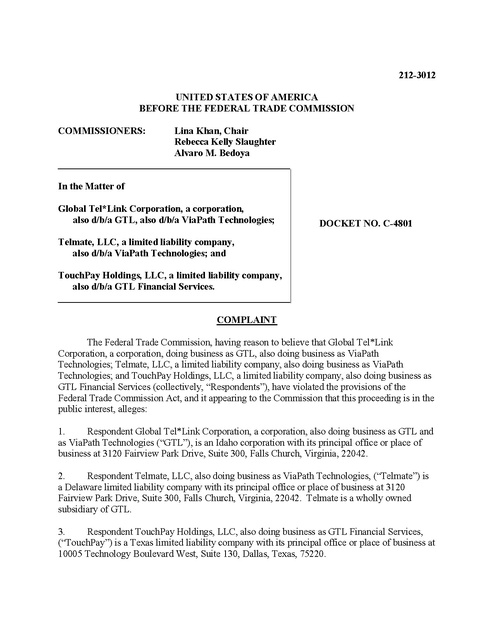
Document text
Document text
This text is machine-read, and may contain errors. Check the original document to verify accuracy.
212-3012
UNITED STATES OF AMERICA
BEFORE THE FEDERAL TRADE COMMISSION
COMMISSIONERS:

Lina Khan, Chair
Rebecca Kelly Slaughter
Alvaro M. Bedoya
________________________________________________
In the Matter of
Global Tel*Link Corporation, a corporation,
also d/b/a GTL, also d/b/a ViaPath Technologies;

DOCKET NO. C-4801

Telmate, LLC, a limited liability company,
also d/b/a ViaPath Technologies; and
TouchPay Holdings, LLC, a limited liability company,
also d/b/a GTL Financial Services.
________________________________________________
COMPLAINT
The Federal Trade Commission, having reason to believe that Global Tel*Link
Corporation, a corporation, doing business as GTL, also doing business as ViaPath
Technologies; Telmate, LLC, a limited liability company, also doing business as ViaPath
Technologies; and TouchPay Holdings, LLC, a limited liability company, also doing business as
GTL Financial Services (collectively, “Respondents”), have violated the provisions of the
Federal Trade Commission Act, and it appearing to the Commission that this proceeding is in the
public interest, alleges:
1.
Respondent Global Tel*Link Corporation, a corporation, also doing business as GTL and
as ViaPath Technologies (“GTL”), is an Idaho corporation with its principal office or place of
business at 3120 Fairview Park Drive, Suite 300, Falls Church, Virginia, 22042.
2.
Respondent Telmate, LLC, also doing business as ViaPath Technologies, (“Telmate”) is
a Delaware limited liability company with its principal office or place of business at 3120
Fairview Park Drive, Suite 300, Falls Church, Virginia, 22042. Telmate is a wholly owned
subsidiary of GTL.
3.
Respondent TouchPay Holdings, LLC, also doing business as GTL Financial Services,
(“TouchPay”) is a Texas limited liability company with its principal office or place of business at
10005 Technology Boulevard West, Suite 130, Dallas, Texas, 75220.

4.
Respondents offer various products and services to jails, prisons, and detention facilities,
to individual consumers incarcerated in these facilities, and to family, friends and other contacts
of incarcerated consumers.
5.
These products and services include communications services for incarcerated
individuals to correspond with their non-incarcerated contacts, and payment services to provide
incarcerated individuals with access to funds. Through these services, Respondents collect a
significant amount of sensitive information from incarcerated individuals and their contacts, such
as their names, addresses, passport numbers, driver’s license numbers, Social Security numbers,
and financial account information.
6.
Respondents have made numerous promises to protect the sensitive personally
identifiable information that they collect in connection with offering their products and services.
However, as alleged below, Respondents failed to employ reasonable data security safeguards to
protect this information. This failure resulted in a security incident that exposed hundreds of
thousands of consumers’ information. Respondents then failed to provide timely notice to
affected consumers so that they could take steps to protect themselves from identity theft. In
addition, Respondents also made multiple misleading representations about the data security
incident. Respondents’ data security failures constitute deceptive and unfair practices in
violation of Section 5(a) of the FTC Act.
7.
Respondents have operated as a common enterprise while engaging in the unlawful acts
and practices alleged below. Respondents have conducted the business practices described
below through an interrelated network of companies that have, among other things, common
ownership and control, common officers and managers, shared office locations, shared resources,
and unified advertising. Because Respondents have operated as a common enterprise, each of
them is jointly and severally liable for the acts and practices alleged below.
8.
The acts and practices of Respondents alleged in this complaint have been in or affecting
commerce, as “commerce” is defined in Section 4 of the Federal Trade Commission Act.
Respondents’ Business Practices
9.
Respondents contract with state Departments of Corrections, the Federal Bureau of
Prisons, county and city jails, immigration detention facilities, and juvenile detention facilities
(collectively, “Facilities”) to provide certain products and services to those Facilities, individuals
incarcerated therein, and incarcerated individuals’ outside contacts. Respondents have
contracted with public and private Facilities located in all 50 states, the District of Columbia, and
Puerto Rico.
10.
Individual users of Respondents’ products and services include people who are
incarcerated in the Facilities. In marketing materials, Respondents have touted that more than
1.9 million incarcerated people, constituting “more than 85% of the U.S. inmate population,” use
GTL’s services. These individuals include both people who have been convicted of crimes and
are incarcerated in prisons and people, such as those held in jails in pre-trial detention, who have
not been convicted of any crime. Additionally, in 2020, Respondents’ services were used by
2

over 13 million consumers who were not incarcerated (e.g., family and friends of incarcerated
people). GTL’s annual net revenue is over $600 million.
11.
The precise products and services provided, and the costs of those products and services
for individual consumers, vary by Facility. If a Facility chooses to engage Respondents’
services, Respondents often require by contract that they be the sole providers of those products
and services within that given Facility. Therefore, incarcerated consumers and their outside
contacts frequently do not have the option of choosing an alternative provider.
12.
Incarcerated consumers access Respondents’ products and services using tablets and
kiosks that are provided by Respondents and are available within Facilities. Consumers who are
not incarcerated can access Respondents’ services through Respondents’ websites and mobile
applications, including www.getttingout.com and the GettingOut mobile applications
(collectively, “GettingOut”) and web.connectnetwork.com and the ConnectNetwork mobile
applications (collectively, “ConnectNetwork”).
13.
Once a consumer has created an account on GettingOut or ConnectNetwork, the
consumer can use the same account to access products and services available through either
brand. For example, consumers who have registered with GettingOut can use GettingOut or
ConnectNetwork to communicate with incarcerated individuals using voice calls, video calls, or
written messages similar to text messages or e-mail. They can also use GettingOut or
ConnectNetwork to make financial deposits to an incarcerated person’s inmate trust account,
allowing the incarcerated individual to use the funds for various purposes including purchasing
items from Facility commissaries, posting bail, and paying fees or fines.
14.
Respondents charge incarcerated consumers and their non-incarcerated contacts to use
these services. These charges vary based on the services used and are established in
Respondents’ contracts with Facilities. For example, to use their communications services,
Respondents have charged consumers rates such as $0.18-0.25 per minute to make a voice call,
$0.25 per minute to make a video call, $1.00 to leave a voicemail message, $0.25 to send a
written message, and $0.25-0.50 for each photo or video attachment to a written message. To
use their payments services to make a deposit, Respondents have in many instances charged
consumers between $2.95 and $11.50 plus 3.5% of the deposit amount.
15.
To create an account to use Respondents’ services, incarcerated consumers and their
contacts are required to provide Respondents with certain personal information, including, in
many cases, their names, addresses, government identification numbers such as passport
numbers or driver’s license numbers, Social Security numbers, and financial account
information.
16.
Using the significant volume of information Respondents collect from incarcerated
individuals and their contacts, Respondents also offer products and services that allow Facilities
to surveil and investigate incarcerated consumers and their non-incarcerated contacts.

3

Data Security Promises
17.
Respondents have made and continue to make various representations regarding their
information security capabilities and practices. For example, Respondents market themselves to
Facilities as an organization that is “security-focused from the inside out,” and that their
“attention is focused on…security,” specifically “preventing data breaches and hacks.”
18.
Since 2017, Respondents have disseminated a YouTube video highlighting the
importance of data security in Respondents’ industry. The video features GTL executives
making the following statements:
a. “GTL is different in data security from our competition” and data security is “the
cornerstone of what we do.”
b. Data security is important for Respondents’ business because incarcerated users use
Respondents’ services to “shar[e] confidential information,” including information
related to commissary services, medical services, and phone services.
c. “A facility that’s looking for a secure environment…should be asking those
questions: have you had a breach? And if you’ve had one, what have you done to
correct it?”
19.
In seeking new or continued business from current and potential Facility customers,
Respondents regularly respond to those Facilities’ Requests for Proposals (“RFPs”). In
numerous instances, as part of the RFP process, Facilities have requested information about
Respondents’ data security practices.
20.
Since May 2017, as part of their RFP responses to Facilities seeking information about
Respondents’ data security practices, Respondents have disseminated or caused to be
disseminated a marketing document entitled “Information Security Framework.” This document
states: “At GTL, we take information security and data protection very seriously. That’s why
we’ve gone to exceptional lengths to safeguard each customer’s data and private information that
is generated through the course of their relationship with us. Our security architecture provides
our customers the reassurance that their data won’t fall into the wrong hands.”
21.
The “Information Security Framework” document goes on to make the following
statements regarding Respondents’ use of specific data security safeguards:
a. “[C]ontrols are in place to limit access only from specific IP addresses. This means
that access to customer data will be denied if a request is from an unknown IP
address.”
b. “[M]ultiple layers of 128-bit encryption and perimeter firewall protection prevent
unauthorized access from the Internet.”

4

c. “A robust centralized log monitoring solution provides alerts to the GTL Information
Security Department based on predefined and internally developed alarm rules. This
application is monitored to detect other anomalies that might indicate inappropriate
use of GTL assets….GTL uses industry accepted log monitoring so[ft]ware to
perform file integrity monitoring and to provide real time monitoring of application,
security, and system event logs. Using this log monitoring so[ft]ware, the GTL
Information Security Department monitors log events 24/7 and investigates all
alerts.”
d. “[A]ny changes to firewall hardware or so[ft]ware or security rules are approved by
GTL’s Information Security Department, follow all change control policies and
procedures, and are properly documented.”
e. “Intrusion Prevention Systems are deployed to alert the GTL Information Security
Department to potential attacks and automatically block such attacks. Many
companies choose to rely on an Intrusion Detection System that simply alerts of
potential attacks, but GTL’s systems automatically block suspected malicious
traffic.”
22.
Since May 2017, in response to RFPs from potential Facility customers, Respondents
have also disseminated or caused to be disseminated a marketing document entitled “Solution
Integration.” This document states: “Our integrated solutions also help enhance data and
technology security. We follow security best practices, the latest encryption methodologies, and
proper protocols to ensure our system offers the most robust data and wireless security in the
market. Our technologies leverage multiple layers of firewalls, SSL, and best-in-industry
security standards to ensure all data transmitted through our systems are secure.”
23.
Respondents have also made security representations to individual consumers. Since at
least January 2020, Respondents have disseminated privacy policies on their public-facing
websites, including on the GettingOut website. These privacy policies have made and continue
to make the following representation: “We seek to use industry standard physical, technical and
administrative security measures designed to protect your personally identifiable information.
However, no data transmission or storage system can be guaranteed to be 100% secure. If you
have reason to believe that your interaction with us is no longer secure (for example, if you feel
that the security of any account you might have with us has been compromised), please
immediately notify us in accordance with the ‘Contact Us’ section above.”
The Test Environment and Respondents’ Data Security Practices
24.
In operating and providing some of their products and services, Respondents rely on
search and storage software (“Search Software”). In 2019, Respondents initiated a process to
transition to a newer version of the Search Software.
25.
The engineers working to plan and execute the Search Software update included
employees of a third-party vendor (the “Vendor”) with which Respondents contract to provide
software development and other services. Respondents’ employees supervised the day-to-day
5

activities of engineers working on the Search Software update, including those employed by the
Vendor.
26.
In or about August 2020, Respondents copied a large volume of production data (i.e., real
data from and about users of Respondents’ products and services) into an Amazon Web Services
(“AWS”) cloud storage environment (the “Test Environment”) for the purpose of testing the new
Search Software version.
27.
As discussed in further detail in Paragraph 31, the data copied to the Test Environment
included personally identifiable information pertaining to numerous incarcerated, nonincarcerated, and Facility users of Respondents’ products and services, including
communications services used by incarcerated consumers and their contacts and monitoring
services used by Facilities.
28.
Though the Test Environment contained personally identifiable information, Respondents
failed to provide reasonable security for that information. Among other things:
a. Respondents did not take any steps to encrypt or otherwise obfuscate the data that
they transferred to the Test Environment, but rather stored consumers’ sensitive,
personally identifiable information in clear, readable text;
b. Respondents did not use automated monitoring software on the Test Environment,
including free AWS features that would have generated alerts if the security settings
of the Test Environment were changed;
c. Respondents did not employ a perimeter firewall to protect the Test Environment;
d. Respondents did not employ a log monitoring solution that provided alerts to the
GTL Information Security Department to protect the Test Environment;
e. Respondents did not employ an Intrusion Prevention System to protect the Test
Environment;
f. Though the Vendor had access to highly sensitive personally identifiable information
held within Respondents’ systems, including the Test Environment, Respondents
took no steps to vet or assess the Vendor’s data security practices;
g. Respondents also did not provide, or require the Vendor to provide, the Vendor’s
engineers with secure development training or with other data security training
appropriate to their job duties; and
h. Respondents did not take reasonable steps to inventory or track consumers’
personally identifiable information, including tracking which consumers’ personally
identifiable information was transferred and the categories of personally identifiable
information that they transferred to the Test Environment.

6

The Incident
29.
On or about August 11, 2020, a technician employed by the Vendor changed the security
settings of the Test Environment. As a result of this change, from at least August 11, 2020 to
August 13, 2020, the Test Environment was left accessible via the internet without password
protection or other access controls to prevent unauthorized persons from accessing and
exfiltrating data from the Environment (“Incident”).
30.
Approximately 649,500 unique individuals’ personally identifiable information was
contained within the Test Environment at the time of the Incident.
31.
This personally identifiable information included individuals’ full names; dates of birth;
phone numbers; usernames or email addresses in combination with passwords; home addresses;
driver’s license numbers; passport numbers; location information; information about individuals’
race, religion, and whether they are transgender; approximately 80,000 grievances submitted by
incarcerated consumers to Facilities; and the content, dates and times, senders, and recipients of
approximately 75,000 written messages that incarcerated and non-incarcerated users had
exchanged using Respondents’ services. In numerous instances, the written messages contained
payment card numbers, financial account information, and Social Security numbers.
32.
The Test Environment also contained a database of deposit information, including data
fields such as “account_posted_at,” “amount,” “card_owner_name,” “deposit_type,” and
“dest_account_id.”
33.
Beginning on or about August 12, 2020, there were multiple instances of access to the
Test Environment from IP addresses not associated with Respondents. Unidentified individuals
accessing the Test Environment from those IP addresses accessed approximately 44,000,000,000
bytes of data stored in the Test Environment. Forensic analysis conducted by or on behalf of
Respondents has indicated that there was exfiltration of data from the Test Environment by one
or more of these individuals.
34.
Respondents learned of the Incident on August 13, 2020, when a security researcher
contacted Respondents and stated that he had discovered “an unprotected, publicly available
database instance which seems to be part of GTL / Telmate cloud infrastructure and contains
non-public information, such as inmates[’] personal details, emails, auth history, messages and
much more.” After confirming the researcher’s findings, Respondents reconfigured the Test
Environment so that it was no longer accessible from the internet.
35.
On September 1, 2020, Respondents received a message from a company that provides
identity monitoring services to consumers stating that the company’s engineers “believe[d] they
[had] come across sensitive data related to GTL.” Following this communication, Respondents
worked with the identity monitoring company to retrieve copies of data that had been released on
the “dark web,” i.e., on websites that are used to buy and sell illicitly obtained data for use in
connection with fraud, identity theft, and other criminal purposes. Subsequent data analysis
suggested that the data provided by the identity monitoring company aligned with data believed
to have been impacted in the Incident.
7

36.
As early as November 2020, Respondents received multiple complaints from consumers
stating that the consumers’ personally identifiable information obtained from Respondents had
been located on the dark web. This personally identifiable information included names,
addresses, phone numbers, dates of birth, and driver’s license issue states. Some consumer
complaints also indicated that consumers had been alerted to fraudulent transactions on their
credit cards following the Incident.
37.
In part as a result of Respondents’ data security failures, hundreds of thousands of
consumers’ personally identifiable information was exposed to the internet, was exfiltrated by
unauthorized individuals, and was made available on the dark web. These failures resulted in
financial injury to consumers, including because consumers experienced unauthorized payment
card activity shortly after learning of the Incident from third-party credit monitoring services.
Additionally, the public exposure of consumers’ communications with loved ones and sensitive
information contained in grievance forms is, at a minimum, a serious invasion of privacy that
may cause them stigma, embarrassment, and/or emotional distress. In some cases, that
information, like consumers’ location information and whether individuals identify as
transgender, has concerning implications for consumers’ safety.
Misrepresentations to Consumers Regarding the Incident
and Failure to Notify Consumers
38.
On September 4, 2020, Comparitech, a data privacy and security blog, published an
article about the Incident. Comparitech’s article contains the following statement, which
Respondents had provided to Comparitech on September 3, 2020 via e-mail:
Telmate, a GTL subsidiary immediately locked down the server as a precaution upon
being made aware of a vulnerability in the data system due to the actions of one of our
vendors. This vulnerability was swiftly corrected, the data security team was
immediately supplemented with the assistance of third-party consultants and we continue
to work closely with law enforcement authorities as we conduct further inquiry into this
incident. Based on the current facts of the investigation, no medical data, passwords, or
consumer payment information were affected. We continue to speak with and notify
necessary parties, including the affected Telmate customers – a small subset of all GTL
customers – about the incident and the actions we have taken to safeguard data. The
security of the data we keep is of the utmost importance to us, and we are committed to
doing everything we can to keep it safe. (Emphasis added.)
39.
Respondents’ statement to Comparitech was false or misleading. Among other reasons,
the statement was false or misleading as to the severity of the Incident and the risk to individual
consumers, because:
a. Respondents stated that their investigation to date had not indicated that medical data
or payment information was affected, but in fact Respondents knew at least as of
August 19, 2020 that some credit card numbers and medical information, including

8

incarcerated consumers’ requests to see medical staff, were included in information
affected by the Incident;
b. Respondents’ statement failed to disclose additional categories of sensitive
personally identifiable information that were affected or potentially affected by the
Incident, including addresses, email addresses, Social Security numbers, passport
numbers, and driver’s license numbers; and
c. Respondents stated that “we continue to speak with and notify necessary parties,
including the affected Telmate customers,” but, in fact, Respondents did not contact
any affected individuals to notify them of the Incident until May 2021.
40.
In or about May 2021, Respondents notified approximately 45,000 individual users that
their personally identifiable information had been exposed as a result of the Incident. To date,
Respondents have provided no notice to the potentially hundreds of thousands of additional users
whose information was contained in the Test Environment at the time of the Incident and
therefore may have been exposed.
41.
Because Respondents delayed notifying individual users that their personally identifiable
information had been or could have been affected by the Incident for approximately nine months,
those users did not have an opportunity to take actions to protect themselves from identity theft,
such as by implementing a credit freeze.
Misrepresentations to Facilities Regarding the Incident
42.
Additionally, on multiple occasions since the Incident, in connection with responding to
RFPs by prospective Facility customers, Respondents have represented that Respondents have
never experienced a data security breach or had not experienced a data security breach within a
particular time frame that includes the dates of the Incident.
43.
For example, since December 2020, Respondents have stated in their RFP responses to
potential Facility customers that “there were no system incidents that resulted in a significant
failure in the achievement of one or more of service commitments and system requirements
throughout the period April 1, 2020, to September 30, 2020,” where “system requirements” are
defined to include that “Logical access to programs, data and computer resources is restricted to
authorized and appropriate users, and such users are restricted to performing authorized and
appropriate actions.”
44.
In other instances, Respondents have submitted RFP responses stating that, e.g.,
Respondents have never experienced a data security breach or have not experienced a data
security breach within the past five years.

9

Count I
Unfair Data Security Practices
45.
As described in Paragraph 28, Respondents failed to employ reasonable and appropriate
measures to protect consumers’ personally identifiable information.
46.
This failure caused or was likely to cause substantial injury to consumers that is not
outweighed by countervailing benefits to consumers or competition and is not reasonably
avoidable by consumers themselves. This practice is an unfair act or practice.
Count II
Unfair Failure to Notify Affected Consumers of the Incident
47.
As described in Paragraphs 38-40, Respondents failed to timely notify affected
consumers that their personally identifiable information had been exposed as a result of the
Incident.
48.
This failure caused or is likely to cause substantial injury to consumers that is not
outweighed by countervailing benefits to consumers or competition and is not reasonably
avoidable by consumers themselves. This practice is an unfair act or practice.
Count III
Misrepresentations Regarding Data Security
49.
As described in Paragraphs 17-23, in connection with the advertising, promotion, offering
for sale, or sale of communications and payment services, Respondents have represented,
directly or indirectly, expressly or by implication, that they implemented reasonable and
appropriate measures to protect personally identifiable information against unauthorized access.
50.
In fact, as described in Paragraph 28, Respondents did not implement reasonable and
appropriate measures to protect personally identifiable information in the Test Environment
against unauthorized access. Therefore, the representation set forth in Paragraph 49 is false or
misleading.
Count IV
Misrepresentations to Individual Users
Regarding the Incident
51.
As described in Paragraph 38, in connection with the advertising, promotion, offering for
sale, or sale of communications and payment services, Respondents represented, directly or
indirectly, expressly or by implication, that they had no reason to believe that consumers’
sensitive personally identifiable information was affected by the Incident.
52.
In fact, as described in Paragraph 39, Respondents had reason to believe that consumers’
sensitive personally identifiable information was affected by the Incident. Therefore, the
representation set out in Paragraph 51 was false or misleading.

10

Count V
Misrepresentations to Individual Users
Regarding Notice
53.
As described in Paragraph 38, in connection with the advertising, promotion, offering for
sale, or sale of communications and payment services, Respondents represented that they would
timely notify users whose personally identifiable information had been exposed as a result of the
Incident.
54.
In fact, as described in Paragraphs 39-41, Respondents failed to provide timely notice to
users whose personally identifiable information was exposed because of the incident. Therefore,
the representation set out in Paragraph 53 was false or misleading.
Count VI
Deceptive Representations to Facilities Regarding the Incident
55.
As described in Paragraphs 42-44 in connection with the advertising, promotion, offering
for sale, or sale of communications and payment services, in multiple instances since the
Incident, Respondents have represented to Facilities that they have never experienced a data
security breach or that they had not experienced a data security breach within a particular
timeframe that includes the dates of the Incident.
56.
In fact, as described in Paragraphs 29-37, the representations set out in Paragraph 55 have
been false or misleading.
Violations of Section 5

57.
The acts and practices of Respondents as alleged in this complaint constitute unfair or
deceptive acts or practices in or affecting commerce in violation of Section 5(a) of the Federal
Trade Commission Act.
THEREFORE, the Federal Trade Commission this 23rd day of February, 2024, has
issued this Complaint against Respondents.
By the Commission.
April J. Tabor
Secretary
SEAL:

11