

Direct Action for Rights and Equality v. Federal Communications Commission, U.S., Petitions for Review of an Order, Telephones, 2025
Download original document:
Document text
Document text
This text is machine-read, and may contain errors. Check the original document to verify accuracy.
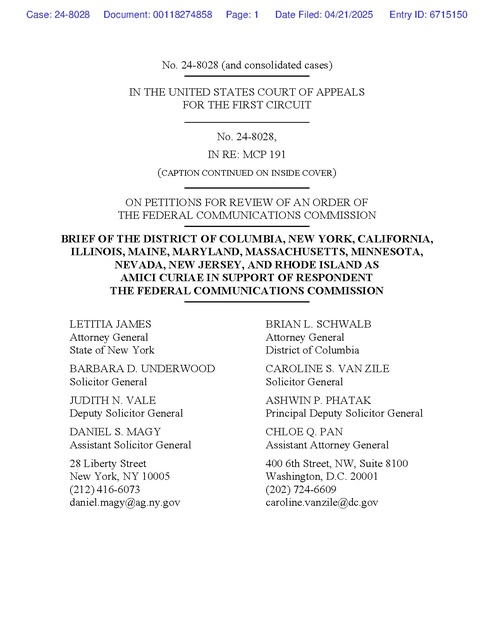
Case: 24-8028

Document: 00118274858

Page: 1

Date Filed: 04/21/2025

Entry ID: 6715150

No. 24-8028 (and consolidated cases)
IN THE UNITED STATES COURT OF APPEALS
FOR THE FIRST CIRCUIT
No. 24-8028,
IN RE: MCP 191
(CAPTION CONTINUED ON INSIDE COVER)
ON PETITIONS FOR REVIEW OF AN ORDER OF
THE FEDERAL COMMUNICATIONS COMMISSION
BRIEF OF THE DISTRICT OF COLUMBIA, NEW YORK, CALIFORNIA,
ILLINOIS, MAINE, MARYLAND, MASSACHUSETTS, MINNESOTA,
NEVADA, NEW JERSEY, AND RHODE ISLAND AS
AMICI CURIAE IN SUPPORT OF RESPONDENT
THE FEDERAL COMMUNICATIONS COMMISSION
LETITIA JAMES
Attorney General
State of New York

BRIAN L. SCHWALB
Attorney General
District of Columbia

BARBARA D. UNDERWOOD
Solicitor General

CAROLINE S. VAN ZILE
Solicitor General

JUDITH N. VALE
Deputy Solicitor General

ASHWIN P. PHATAK
Principal Deputy Solicitor General

DANIEL S. MAGY
Assistant Solicitor General

CHLOE Q. PAN
Assistant Attorney General

28 Liberty Street
New York, NY 10005
(212) 416-6073
daniel.magy@ag.ny.gov

400 6th Street, NW, Suite 8100
Washington, D.C. 20001
(202) 724-6609
caroline.vanzile@dc.gov

Case: 24-8028

Document: 00118274858

Page: 2

Date Filed: 04/21/2025

Entry ID: 6715150

(CAPTION CONTINUED FROM FRONT COVER)
No. 24-1814,
DIRECT ACTION FOR RIGHTS AND EQUALITY,
PETITIONER,
V.

FEDERAL COMMUNICATIONS COMMISSION
AND UNITED STATES OF AMERICA,
RESPONDENTS.
No. 24-1859,
CRIMINAL JUSTICE REFORM CLINIC,
PETITIONER,
V.

FEDERAL COMMUNICATIONS COMMISSION
AND UNITED STATES OF AMERICA,
RESPONDENTS.
No. 24-1860,
SECURUS TECHNOLOGIES, LLC,
PETITIONER,
GLOBAL TEL*LINK, D/B/A VIAPATH TECHNOLOGIES,
INTERVENOR FOR PETITIONER,
V.

FEDERAL COMMUNICATIONS COMMISSION
AND UNITED STATES OF AMERICA,
RESPONDENTS,
DIRECT ACTION FOR RIGHTS AND EQUALITY, INC., et al.,
INTERVENORS FOR RESPONDENTS.

ii

Case: 24-8028

Document: 00118274858

Page: 3

Date Filed: 04/21/2025

(CAPTION CONTINUED FROM PREVIOUS PAGE)
No. 24-1861,
PENNSYLVANIA PRISON SOCIETY,
PETITIONER,
V.

FEDERAL COMMUNICATIONS COMMISSION
AND UNITED STATES OF AMERICA,
RESPONDENTS.
No. 24-1884,
DIRECT ACTION FOR RIGHTS AND EQUALITY,
PETITIONER,
V.

FEDERAL COMMUNICATIONS COMMISSION
AND UNITED STATES OF AMERICA,
RESPONDENTS,
SECURUS TECHNOLOGIES, LLC,
INTERVENOR FOR RESPONDENTS.
No. 24-1886,
PENNSYLVANIA PRISON SOCIETY,
PETITIONER,
V.

FEDERAL COMMUNICATIONS COMMISSION
AND UNITED STATES OF AMERICA,
RESPONDENTS,
SECURUS TECHNOLOGIES, LLC,
INTERVENOR FOR RESPONDENTS.

iii

Entry ID: 6715150

Case: 24-8028

Document: 00118274858

Page: 4

Date Filed: 04/21/2025

Entry ID: 6715150

(CAPTION CONTINUED FROM PREVIOUS PAGE)
No. 24-1922,
CRIMINAL JUSTICE REFORM CLINIC,
PETITIONER,
V.

FEDERAL COMMUNICATIONS COMMISSION
AND UNITED STATES OF AMERICA,
RESPONDENTS,
SECURUS TECHNOLOGIES, LLC,
INTERVENOR FOR RESPONDENTS.
No. 24-1927,
SECURUS TECHNOLOGIES, LLC,
PETITIONER,
GLOBAL TEL*LINK, D/B/A VIAPATH TECHNOLOGIES,
INTERVENOR FOR PETITIONER,
V.

FEDERAL COMMUNICATIONS COMMISSION
AND UNITED STATES OF AMERICA,
RESPONDENTS,
DIRECT ACTION FOR RIGHTS AND EQUALITY, INC., et al.,
INTERVENORS FOR RESPONDENTS.

iv

Case: 24-8028

Document: 00118274858

Page: 5

Date Filed: 04/21/2025

Entry ID: 6715150

(CAPTION CONTINUED FROM PREVIOUS PAGE)
No. 24-1969,
PAY TEL COMMUNICATIONS, INC.,
PETITIONER,
GLOBAL TEL*LINK, D/B/A VIAPATH TECHNOLOGIES,
INTERVENOR FOR PETITIONER,
V.

FEDERAL COMMUNICATIONS COMMISSION
AND UNITED STATES OF AMERICA,
RESPONDENTS,
PENNSYLVANIA PRISON SOCIETY, et al.,
INTERVENORS FOR RESPONDENTS.
No. 24-2013,
STATE OF INDIANA, et al.,
PETITIONER,
GLOBAL TEL*LINK, D/B/A VIAPATH TECHNOLOGIES,
INTERVENOR FOR PETITIONERS,
V.

FEDERAL COMMUNICATIONS COMMISSION
AND UNITED STATES OF AMERICA,
RESPONDENTS,
OFFICE OF COMMUNICATION OF THE UNITED CHURCH
OF CHRIST, INC., et al.,
INTERVENORS FOR RESPONDENTS.

v

Case: 24-8028

Document: 00118274858

Page: 6

Date Filed: 04/21/2025

Entry ID: 6715150

(CAPTION CONTINUED FROM PREVIOUS PAGE)
No. 24-2061,
STATE OF LOUISIANA, et al.,
PETITIONER,
GLOBAL TEL*LINK, D/B/A VIAPATH TECHNOLOGIES
AND NATIONAL SHERIFFS’ ASSOCIATION,
INTERVENORS FOR PETITIONER,
V.

FEDERAL COMMUNICATIONS COMMISSION
AND UNITED STATES OF AMERICA,
RESPONDENTS,
DIRECT ACTION FOR RIGHTS AND EQUALITY, INC., et al.,
INTERVENORS FOR RESPONDENTS.

vi

Case: 24-8028

Document: 00118274858

Page: 7

Date Filed: 04/21/2025

Entry ID: 6715150

TABLE OF CONTENTS
INTRODUCTION AND INTEREST OF AMICI CURIAE ......................................1
SUMMARY OF ARGUMENT .................................................................................3
ARGUMENT .............................................................................................................5
I.

II.

The FCC’s Order Promotes Positive Family And Societal
Relationships, Which Help Incarcerated Individuals
Successfully Rehabilitate. .....................................................................5
A.

The cost of calling for incarcerated individuals is often
prohibitively high and inhibits their ability to maintain
strong ties to community support structures. ..............................5

B.

Maintaining incarcerated individuals’ social support
promotes public safety by helping offenders transition
back into their communities upon release and reducing
long-term recidivism. ................................................................10

C.

Frequent
communication
between
incarcerated
individuals and their families promotes improved
outcomes for offenders’ families and children. ........................12

Amici States’ Experience Confirms That Implementing
Affordable IPCS Rates Is Feasible Without Sacrificing Facility
or Public Safety. ..................................................................................14

CONCLUSION ........................................................................................................19

vii

Case: 24-8028

Document: 00118274858

Page: 8

Date Filed: 04/21/2025

Entry ID: 6715150

TABLE OF AUTHORITIES
Cases
Carpenter v. Pallito,
No. 531-9-13 WNCV, 2014 WL 5795286 (Vt. Super. Ct. Aug. 13, 2014) ........ 5
Samson v. California,
547 U.S. 843 (2006) ........................................................................................... 10
Statutes
Cal. Pen. Code § 2084.5 (West 2023)..................................................................... 16
Cal. Welf. & Inst. Code § 208.1 (West 2023) ........................................................ 16
N.Y. Corr. Law § 623(3) ......................................................................................... 17
Administrative Materials
Incarcerated People’s Communication Services; Implementation of the
Martha Wright-Reed Act; Rates for Interstate Inmate Calling Services,
89 Fed. Reg. 77,244 (Sept. 20, 2024) ............................................................. 1, 2
Rates for Interstate Inmate Calling Services, Report and Order and Further
Notice of Proposed Rulemaking, 28 FCC Rcd. 14107
(released Sept. 26, 2013).............................................................................. 17, 18
Report and Order, Order on Reconsideration, Clarification and Waiver, and
Further Notice of Proposed Rulemaking, Incarcerated People’s
Communications Services; Implementation of the Martha Wright-Reed
Act: Rates for Interstate Inmate Calling Services, WC Docket Nos. 23-62
& 12-375, FCC 24-75 (released July 22, 2024) ......................................... passim
Legislative Materials
S. 1541, 117th Cong. (2022) ..................................................................................... 2
S.B. 1008, Reg. Sess. (Ca. 2022) ............................................................................ 16

viii

Case: 24-8028

Document: 00118274858

Page: 9

Date Filed: 04/21/2025

Entry ID: 6715150

Other Authorities
Aaron Littman, Free-World Law Behind Bars,
113 Yale L.J. 1385 (2022) ................................................................................. 11
Aleks Kajstura, Most incarcerated people will return home; the Census
Bureau should count them there, Prison Pol’y Initiative (May 14, 2024),
https://tinyurl.com/5ahnjjpa ............................................................................... 10
Amy B. Cyphert, Prisoners of Fate: The Challenges of Creating Change for
Children of Incarcerated Parents, 77 Md. L. Rev. 385 (2018)................... 12, 13
Beatrix Lockwood & Nicole Lewis, The Long Journey to Visit a Family
Member in Prison, The Marshall Project (Dec. 18, 2019),
https://tinyurl.com/ycjemev2 ............................................................................... 6
Bonita Tenneriello & Elizabeth Matos, The Telephone Is A Lifeline For
Prison Families And Calls Are Outrageously Expensive, WBUR
(Jan. 27, 2020), https://tinyurl.com/yefnrr2j.................................................... 5, 7
Bryce Peterson et al., Model Practices for Parents in Prisons and Jails:
Reducing Barriers to Family Connections (Urb. Inst. et al., July 2019) ........... 13
Candice Norwood, A mother's calling: Inside the fight to make prison phone
calls free in Connecticut, Conn. Pub. Radio (May 31, 2024),
https://tinyurl.com/yjk8cyh4 ................................................................................ 9
Danielle L. Haverkate & Kevin A. Wright, The differential effects of prison
contact on parent–child relationship quality and child behavioral changes
26 (Corr.: Pol’y, Prac. & Rsch., 2020) ........................................................ 13, 14
Emilia Calma & Yesim Sayin, Map of the week: Where are D.C. Code
offenders housed today?, D.C. Pol’y Ctr. (Mar. 10, 2023),
https://tinyurl.com/4bsjsttw ............................................................................. 5, 6
Fed. Bureau of Prisons, U.S. Dep’t of Just., Program Statement No. 5264.07
(Jan. 31, 2002), https://tinyurl.com/5n7xfaa4.................................................... 12

ix

Case: 24-8028

Document: 00118274858

Page: 10

Date Filed: 04/21/2025

Entry ID: 6715150

Jocelyn Fontaine et al., The Urban Institute, Families and Reentry: Unpacking
How Social Support Matters (Ill. Crim. Just. Info. Auth., Jul. 27, 2012),
https://tinyurl.com/4pmxwkjm .................................................................... 10, 11
Johanna B. Folk et al., Behind Bars but Connected to Family: Evidence for
the
Benefits
of
Family
Contact
During
Incarceration
(J. Fam. Psych., June 2019) ................................................................................. 6
Julie Poehlmann et al., Children’s Contact With Their Incarcerated Parents
(Am. Psych., Sept. 2010) ............................................................................. 13, 14
Kelle Barrick et al., Reentering Women: The Impact of Social Ties on LongTerm Recidivism, 94 Prison J. 279 (2014) ......................................................... 11
Kyle C. Ward et al., Identifying the Impact of Incarceration on Parenting: An
Examination of Incarcerated Parents’ Perceptions in the “Reading for a
Change” Program in Colorado, 102 Prison J. 626 (2022) ............................... 13
Letter from Anthony J. Annucci, Acting Comm’r, N.Y. Dept. of Corr. &
Comm. Supervision, to Gregory V. Haledjian, Att’y-Advisor, Fed.
Commc’ns Comm’n (July 8, 2013) ................................................................... 17
Letter from Bianca Tylek, Exec. Dir., Worth Rises, to Marlene H. Dortch,
Sec’y, Fed. Commc’ns Comm’n (Nov. 23, 2020). ............................................ 16
Letter from Stefen R. Short, Chief Couns., Worth Rises, to Marlene H. Dortch,
Sec’y, Fed. Commc’ns Comm’n (May 17, 2024) ............................................. 15
Nazish Dholakia, The FCC Is Capping Outrageous Prison Phone Rates, but
Companies Are Still Price Gouging, Vera Inst. (Sept. 4, 2024),
https://tinyurl.com/4krst2zt .............................................................................. 6, 7
New Prepaid Phone Plans Without the Gotcha, Metro by T-Mobile,
https://tinyurl.com/42u7w9kx .............................................................................. 7
Parajita Charles et al., Parenting and Incarceration: Perspectives on FatherChild Involvement during Reentry from Prison, 93 Soc. Serv. Rev. 218
(2019) ................................................................................................................ 14

x

Case: 24-8028

Document: 00118274858

Page: 11

Date Filed: 04/21/2025

Entry ID: 6715150

Peter Wagner & Wanda Bertram, State of Phone Justice 2022: The problem,
the progress, and what’s next, Prison Pol’y Initiative (Dec. 2022),
https://tinyurl.com/yc23n59b ............................................................................... 7
Premium Wireless Plans Starting at $15/Mo, Mint Mobile,
https://tinyurl.com/bddfuyfh ................................................................................ 7
Press Release, Fed. Commc’ns Comm’n, FCC Caps Exorbitant Phone &
Video Call Rates for Incarcerated Persons & Their Families
(July 18, 2024), https://tinyurl.com/mvttvmpk .................................................... 2
Press Release, Worth Rises, FCC Votes Unanimously to Significantly Lower
Phone and Video Communication Costs After Decades of Exploitation by
Prison Telecoms (July 18, 2024), https://tinyurl.com/3rzmj8vb ......................... 2
Rebecca L. Naser & Nancy G. La Vigne, Family Support in the Prisoner
Reentry Process: Expectations and Realities, 43 J. Offender Rehabilitation
93 (2006) ............................................................................................................ 11
Roby Chavez, Incarcerated people face heightened costs to communicate with
families, PBS (Apr. 7, 2023), https://tinyurl.com/34m57rcw.............................. 6
Roby Chavez, The high cost of staying in touch while incarcerated can linger
long after release, PBS (Apr. 3, 2023), https://tinyurl.com/ycy68fjs ................. 8
Saneta deVuono-powell et al., Who Pays? The True Cost of Incarceration on
Families 30 (Ella Baker Ctr. for Human Rts. et al., Sept. 2015) ......................... 7
Sarah Betancourt, Massachusetts prison and jail calls doubled in first year of
free calls, WGBH (Nov. 17, 2023), https://tinyurl.com/bdbbkeee ................... 16
Securus Phone System, N.Y. Dept. of Corr. & Comm. Supervision,
https://tinyurl.com/4t7jx45v .............................................................................. 17
The Council of State Gov’ts Just. Ctr., 50 States, 1 Goal: Examining StateLevel Recidivism Trends in the Second Chance Act Era (Apr. 2024),
https://tinyurl.com/n6j83vb9.............................................................................. 10
Emma Kaufman, The Prisoner Trade,
133 Harv. L. Rev. 1815 (2020) ........................................................................ 5, 9
xi

Case: 24-8028

Document: 00118274858

Page: 12

Date Filed: 04/21/2025

Entry ID: 6715150

The Sent’g Project, Parents in Prison (Feb. 2021),
https://tinyurl.com/3drw3f9f ...........................................................................5, 12

xii

Case: 24-8028

Document: 00118274858

Page: 13

Date Filed: 04/21/2025

Entry ID: 6715150

INTRODUCTION AND INTEREST OF AMICI CURIAE
The District of Columbia, New York, California, Illinois, Maine, Maryland,
Massachusetts, Minnesota, Nevada, New Jersey, and Rhode Island (collectively,
“Amici States”) file this brief as amici curiae in support of respondent the Federal
Communications Commission (FCC) and its rule capping the cost of phone and
video call rates for incarcerated people and their families. See Report and Order,
Order on Reconsideration, Clarification and Waiver, and Further Notice of Proposed
Rulemaking, Incarcerated People’s Communications Services; Implementation of
the Martha Wright-Reed Act: Rates for Interstate Inmate Calling Services, WC
Docket Nos. 23-62 & 12-375, FCC 24-75 (released July 22, 2024) (hereinafter 2024
Order).
In 2022, Congress passed the Martha Wright-Reed Just and Reasonable
Communications Act (MWRA) with bipartisan support, significantly expanding the
FCC’s jurisdiction over incarcerated people’s communications services (IPCS).
Incarcerated People’s Communication Services; Implementation of the Martha
Wright-Reed Act; Rates for Interstate Inmate Calling Services, 89 Fed. Reg. 77,244
(Sept. 20, 2024). Congress passed the MWRA in recognition of the work of Martha
Wright-Reed, a grandmother who spent decades advocating to reduce prohibitively
high IPCS costs after she was forced to pay hundreds of dollars each month to stay
in contact with her incarcerated grandson. Id. at 77,244. The MWRA was also a

Case: 24-8028

Document: 00118274858

Page: 14

Date Filed: 04/21/2025

Entry ID: 6715150

direct response to years of litigation by IPCS providers seeking to thwart FCC efforts
to reform correctional facility telecommunications costs. Id. The MWRA amended
the Communications Act of 1934 to direct the FCC to “ensure just and reasonable
charges for telephone and advanced communications services in correctional and
detention facilities.” S. 1541, 117th Cong. (2022).
In 2024, to implement the MWRA’s requirements, the FCC voted
unanimously to enact the Order under review in this case. To ensure “just and
reasonable rates for IPCS consumers and fair compensation for IPCS providers,”
2024 Order at 22, the Order: (1) lowered per-minute rate caps for phone calls,
excluding most security costs from the rate; (2) established interim caps for video
communications; (3) eliminated ancillary fees; and (4) prohibited site commissions
between correctional facilities and IPCS providers. Under the 2024 Order, the cost
of a 15-minute phone call drops from as much as $11.35 in large jails to $0.90, and
from $12.10 in small jails to $1.35. Press Release, Fed. Commc’ns Comm’n, FCC
Caps Exorbitant Phone & Video Call Rates for Incarcerated Persons & Their
Families (July 18, 2024), https://tinyurl.com/mvttvmpk. By one estimate, the 2024
Order will affect 83% of incarcerated people and save families at least $500 million
annually. Press Release, Worth Rises, FCC Votes Unanimously to Significantly
Lower Phone and Video Communication Costs After Decades of Exploitation by
Prison Telecoms (July 18, 2024), https://tinyurl.com/3rzmj8vb.

2

Case: 24-8028

Document: 00118274858

Page: 15

Date Filed: 04/21/2025

Entry ID: 6715150

Amici States have strong interests in this Court upholding the 2024 Order.
Amici States operate correctional facilities covered by the Order and seek to maintain
security within those facilities while enhancing broader public safety. Providing
affordable IPCS serves both goals. Phone and video call services are often the
primary lifeline between incarcerated people and the outside world and are critical
for facilitating greater connections with loved ones. These deepened community
connections promote successful rehabilitation, reduce recidivism, and even improve
outcomes for the children and family members of incarcerated people. Moreover,
reasonable IPCS rates achieve these critical public safety enhancements without
undermining security at correctional facilities. Amici States therefore have an
interest in ensuring that low-cost correctional facility phone and video call services
are available where feasible.
SUMMARY OF ARGUMENT
I. The 2024 Order promotes public safety by addressing the exorbitant costs
of making calls for incarcerated individuals. These prohibitive rates are driven by
predatory practices that often have little relation to the actual cost of providing IPCS.
Instead, IPCS providers leverage the fact that incarcerated individuals have no
choice but to pay calling rates—no matter how high—if they want to stay in touch
with loved ones. And maintaining regular contact with family and community is
crucial for helping incarcerated individuals successfully reenter society and reducing

3

Case: 24-8028

Document: 00118274858

Page: 16

Date Filed: 04/21/2025

Entry ID: 6715150

recidivism. Frequent communication also promotes family stability and improves
developmental outcomes for children with incarcerated parents.
II. Amici States’ extensive experience demonstrates that implementing
reasonable IPCS rates is feasible without sacrificing facility or public safety. Amici
States operate correctional facilities covered by the 2024 Order and negotiate with
providers over IPCS rates charged in those facilities. Several States have made IPCS
free. Other States have lowered their IPCS rates to levels that are far below the rate
caps set in the 2024 Order. These States have all seen significant benefits from the
elimination or reduction of rates, including increased family reunification for
incarcerated individuals upon release. Rate reductions have also led to facility safety
benefits, like curtailing illicit cell phone use by incarcerated people and keeping
incarcerated individuals meaningfully engaged with their communities.

Thus,

contrary to State Petitioners’ contentions, there is no reason to believe that the 2024
Order’s rate caps will jeopardize public or correctional-facility safety or lead to a
reduction in the availability of calling services for incarcerated individuals.

4

Case: 24-8028

Document: 00118274858

Page: 17

Date Filed: 04/21/2025

Entry ID: 6715150

ARGUMENT
I.

The FCC’s Order Promotes Positive Family And Societal Relationships,
Which Help Incarcerated Individuals Successfully Rehabilitate.
A.

The cost of calling for incarcerated individuals is often
prohibitively high and inhibits their ability to maintain strong ties
to community support structures.

When people are incarcerated, their connection to loved ones becomes both
precious and precarious. Telephone and video calls serve as vital lifelines for
sustaining family and community connection. See, e.g., Bonita Tenneriello &
Elizabeth Matos, The Telephone Is A Lifeline For Prison Families And Calls Are
Outrageously Expensive, WBUR (Jan. 27, 2020), https://tinyurl.com/yefnrr2j. In
the United States, people in prison are incarcerated, on average, more than 100 miles
from their homes.

The Sent’g Project, Parents in Prison 2 (Feb. 2021),

https://tinyurl.com/3drw3f9f. These statistics are even starker for some incarcerated
communities. For example, since 1998, the Vermont Department of Corrections has
sent incarcerated individuals out of state due to lack of correctional facility capacity.
See Carpenter v. Pallito, No. 531-9-13 WNCV, 2014 WL 5795286 (Vt. Super. Ct.
Aug. 13, 2014). Hawaii houses nearly half of its incarcerated individuals on the
mainland. See Emma Kaufman, The Prisoner Trade, 133 Harv. L. Rev. 1815, 1818
(2020). And District of Columbia offenders are routinely incarcerated hundreds of
miles away from home, including in California and Puerto Rico. Emilia Calma &
Yesim Sayin, Map of the week: Where are D.C. Code offenders housed today?, D.C.
5

Case: 24-8028

Document: 00118274858

Page: 18

Date Filed: 04/21/2025

Entry ID: 6715150

Pol’y Ctr. (Mar. 10, 2023), https://tinyurl.com/4bsjsttw. Correctional facilities are
also often located in isolated locations that are not readily accessible by public
transportation. Beatrix Lockwood & Nicole Lewis, The Long Journey to Visit a
Family

Member

in Prison,

The

Marshall

Project

(Dec.

18,

2019),

https://tinyurl.com/ycjemev2. Such barriers can make it difficult for family and
friends to visit incarcerated loved ones. Johanna B. Folk et al., Behind Bars but
Connected to Family: Evidence for the Benefits of Family Contact During
Incarceration 15 (J. Fam. Psych., June 2019) (noting that “distance, lack of
transportation, and the cost of traveling to correctional facilities are often
prohibitive” for in-person visitation).
Telephone and video calls are critical for helping incarcerated individuals stay
connected to family and friends, but exorbitant rates have long been a substantial
barrier to maintaining community bonds while in correctional facilities. 2024 Order
at 17. For incarcerated individuals, the average cost of a single 15-minute phone
call

is

$3.

Roby

Chavez,

Incarcerated

people

face

heightened

costs to communicate with families, PBS (Apr. 7, 2023), https://tinyurl.com/34m57
rcw. Some family members spend as much as $500 per month for such calls and
must work multiple jobs to afford to stay in touch with incarcerated loved ones.
Nazish Dholakia, The FCC Is Capping Outrageous Prison Phone Rates, but
Companies Are Still Price Gouging, Vera Inst. (Sept. 4, 2024), https://tinyurl.com/

6

Case: 24-8028

Document: 00118274858

Page: 19

Date Filed: 04/21/2025

Entry ID: 6715150

4krst2zt. As one survey found, the most frequent barrier to maintaining contact with
incarcerated family members is the cost of calls. See Saneta deVuono-powell et al.,
Who Pays? The True Cost of Incarceration on Families 30 (Ella Baker Ctr. for
Human Rts. et al., Sept. 2015). And the FCC’s administrative record here contains
“overwhelming evidence of the substantial burden excessive communications rates
have on the ability of incarcerated people to stay connected” with their support
systems.1 2024 Order at 16.
Beyond per-minute calling costs, incarcerated individuals and their families
are also subject to ancillary service charges that have “inflated the effective price
paid for inmate calling services.” Id. at 7 n.27. These fees, which may be charged
for reasons as mundane as opening, funding, or closing a prepaid phone account, can
add up to nearly 40% of the amounts that incarcerated individuals and their families
spend on calls. Peter Wagner & Wanda Bertram, State of Phone Justice 2022: The
problem, the progress, and what’s next, Prison Pol’y Initiative (Dec. 2022),
https://tinyurl.com/yc23n59b.

For example, simply depositing $50 into an

Generally, calling rates charged in prisons far exceed calling costs outside of
those facilities. Standard telecommunications carriers now offer phone customers
unlimited calling in the United States for just $15 to $25 a month. See, e.g., Premium
Wireless Plans Starting at $15/Mo, Mint Mobile, https://tinyurl.com/bddfuyfh; New
Prepaid Phone Plans Without the Gotcha, Metro by T-Mobile,
https://tinyurl.com/42u7w9kx. “While the free world barely notices cheap, flat-rate
phone calls, prison families pay sky-high rates.” Tenneriello & Matos, supra.
1

7

Case: 24-8028

Document: 00118274858

Page: 20

Date Filed: 04/21/2025

Entry ID: 6715150

incarcerated person’s phone account can trigger $18 in extra fees. Roby Chavez,
The high cost of staying in touch while incarcerated can linger long after
release, PBS (Apr. 3, 2023), https://tinyurl.com/ycy68fjs.
Moreover, IPCS providers are known to impose “multiple fees for the same
transaction, as a way of exacting revenue from consumers.” 2024 Order at 70. For
instance, some providers charge “both an automated payment fee and a fee for the
card processor costs for the same transactions,” causing incarcerated individuals to
pay, on average, 21% more than they otherwise would. Id. at 70 n.445 & 225 n.1506.
Providers will also charge multiple “single call” fees when calls are disconnected
and reconnected, which can more than triple the cost of a call. Id. at 71 n.448. These
fees bear little to no relation to the actual costs of providing IPCS and primarily serve
as a mechanism for increasing provider profits. 2 See id. at 70 & 224 n.1505. This
double-dipping is an “endemic feature” of the IPCS provider market and comes at
the expense of incarcerated people and their families. Id. at 74.
Site commissions to correctional facilities have also inflated the cost of calls.
Correctional authorities sometimes award contracts to IPCS providers based on the
amount of revenue that the provider is willing to share with the facility. Id. at 133-

Amici States recognize that important fiscal considerations must be balanced
when establishing IPCS rates. But excessively high rates are not necessary to recoup
operational costs and undermine broader public interest in supporting community
connection and rehabilitation for incarcerated people.
2

8

Case: 24-8028

Document: 00118274858

Page: 21

Date Filed: 04/21/2025

Entry ID: 6715150

35. This practice can create “reverse competition” because correctional institutions
and IPCS providers share the same financial interest in generating the highest
payments possible. Id. at 138-39. The cost of these site commissions ultimately get
passed on to incarcerated people and their loved ones. Id. at 138.
These multi-layered costs are prohibitively expensive for many incarcerated
individuals, who are disproportionately low-income. See Kaufman, supra, at 1857.
The median annual income of an individual prior to incarceration is just $19,185.
Id. On average, incarcerated individuals earn fourteen to sixty-three cents per hour
for their labor in correctional facilities. Id. at 1858 n.246. Consequently, the costs
for telephone and video calls often fall on incarcerated individuals’ family members,
who are also disproportionately likely to have lower incomes. See id. at 1857.
As an example, one mother reported spending more than 20% of her $2,000
monthly paycheck to stay in contact with her incarcerated 17-year-old son. Candice
Norwood, A mother's calling: Inside the fight to make prison phone calls free in
Connecticut, Conn. Pub. Radio (May 31, 2024), https://tinyurl.com/yjk8cyh4. This
sometimes caused her to be late on bills and to have her utilities cut off, and she
“would often work all day and skip eating lunch to save money.” Id. Indeed, as the
FCC found here, the “high costs of keeping in contact drive more than 1 in 3 families,
who are already financially burdened, into debt for phone calls and visits with their
loved ones.” 2024 Order at 16.

9

Case: 24-8028

B.

Document: 00118274858

Page: 22

Date Filed: 04/21/2025

Entry ID: 6715150

Maintaining incarcerated individuals’ social support promotes
public safety by helping offenders transition back into their
communities upon release and reducing long-term recidivism.

As the FCC recognized, the 2024 Order will help incarcerated individuals
successfully reenter society and reduce recidivism rates by making telephone and
video calling more affordable. 2024 Order at 19. Recidivism is a serious public
safety concern throughout the country, and States have a significant interest in
reducing recidivism rates in their communities. See Samson v. California, 547 U.S.
843, 854 (2006). Reduced recidivism means fewer crime victims and reduced public
expenses from incarceration. For instance, the Council of State Governments
estimates that States “will collectively spend an estimated $8 billion to reincarcerate
people who were released from prison in 2022.” The Council of State Gov’ts Just.
Ctr., 50 States, 1 Goal: Examining State-Level Recidivism Trends in the Second
Chance Act Era 5 (Apr. 2024), https://tinyurl.com/n6j83vb9.
After their release, incarcerated people usually return to their home
communities. Aleks Kajstura, Most incarcerated people will return home; the
Census Bureau should count them there, Prison Pol’y Initiative (May 14, 2024),
https://tinyurl.com/5ahnjjpa. And families and social support play a critical role in
helping formerly incarcerated individuals successfully transition back into society
and avoid reoffending. See Jocelyn Fontaine et al., The Urban Institute, Families
and

Reentry:

Unpacking

How

Social

10

Support

Matters

1

(Ill.

Crim.

Case: 24-8028

Document: 00118274858

Page: 23

Date Filed: 04/21/2025

Entry ID: 6715150

Just. Info. Auth., Jul. 27, 2012) (listing studies), https://tinyurl.com/4pmxwkjm.
For example, formerly incarcerated individuals often rely “very heavily on their
families for support in navigating virtually every aspect of the reentry experience,
from assistance with housing and employment to financial support and overall
encouragement.” Rebecca L. Naser & Nancy G. La Vigne, Family Support in the
Prisoner Reentry Process: Expectations and Realities, 43 J. Offender Rehabilitation
93, 102 (2006).
Strong statistical evidence, including data collected by state departments of
corrections, demonstrates that maintaining family contact during incarceration can
substantially reduce rates of disciplinary infractions and post-release recidivism.
Aaron Littman, Free-World Law Behind Bars, 113 Yale L.J. 1385, 1440 (2022). As
the FCC explained, research has repeatedly “linked regular contact with family with
lowering rates of recidivism and increasing likelihood of successful reentry into
society after release.” 2024 Order at 19. For example, a 2014 study of high-risk
incarcerated women found that those with more frequent family contact through
phone calls during incarceration were less likely to be reincarcerated in the first five
years after their release. Kelle Barrick et al., Reentering Women: The Impact of
Social Ties on Long-Term Recidivism, 94 Prison J. 279, 293 (2014). “Furthermore,
when separately examining types of contact, familial telephone contact was most
consistently associated with reductions in recidivism.” Id. at 298. And the federal

11

Case: 24-8028

Document: 00118274858

Page: 24

Date Filed: 04/21/2025

Entry ID: 6715150

Bureau of Prisons has similarly recognized that telephone contact is an important
“means of maintaining community and family ties that will contribute to an inmate’s
personal development.” Fed. Bureau of Prisons, U.S. Dep’t of Just., Program
Statement No. 5264.07, at 1 (Jan. 31, 2002), https://tinyurl.com/5n7xfaa4.
In short, one way to reduce recidivism is to create meaningful opportunities
for incarcerated people to remain engaged with their communities, including
reducing the costs of communications between them. From a fiscal perspective,
implementing low-cost IPCS translates to significant taxpayer savings in criminal
justice costs incurred due to recidivism, re-prosecution, and reincarceration.
C.

Frequent communication between incarcerated individuals and
their families promotes improved outcomes for offenders’ families
and children.

The affordable telephone and video calling rates implemented under the 2024
Order will also improve outcomes for the children and families of incarcerated
individuals. Approximately 2.7 million children in the United States have a parent
who is incarcerated. Parents in Prison, supra, at 1. In some States, the percentage
of children with parents who are incarcerated is as high as 13%. Id. Having an
incarcerated parent can negatively affect aspects of a child’s emotional,
psychological, and educational development. Amy B. Cyphert, Prisoners of Fate:
The Challenges of Creating Change for Children of Incarcerated Parents, 77 Md.

12

Case: 24-8028

Document: 00118274858

Page: 25

Date Filed: 04/21/2025

Entry ID: 6715150

L. Rev. 385, 290 (2018). The disruption of parental attachment increases rates of
childhood depression and anxiety and can disrupt academic performance. Id. at 391.
Decades of research demonstrates that maintaining contact between a child
and their incarcerated parent is an important way to mitigate these harms to children.
See id. at 395; Kyle C. Ward et al., Identifying the Impact of Incarceration on
Parenting: An Examination of Incarcerated Parents’ Perceptions in the “Reading
for a Change” Program in Colorado, 102 Prison J. 626, 627 (2022). Phone calls
serve as a particularly crucial medium of parent-child contact because they remove
negative stressors associated with in-person visits, such as undergoing strip searches
and seeing parents behind Plexiglas barriers. See Bryce Peterson et al., Model
Practices for Parents in Prisons and Jails: Reducing Barriers to Family Connections
50, 52, 59 (Urb. Inst. et al., July 2019).
For instance, a 2020 study found that children developed better relationships
with their incarcerated parents when they communicated weekly through phone
calls. Danielle L. Haverkate & Kevin A. Wright, The differential effects of prison
contact on parent–child relationship quality and child behavioral changes 26 (Corr.:
Pol’y, Prac. & Rsch., 2020). Other studies from the last two decades have repeatedly
found positive associations between contact and relationship perceptions for
children and incarcerated parents. See Julie Poehlmann et al., Children’s Contact
With Their Incarcerated Parents 7, 31-35 (Am. Psych., Sept. 2010). “[G]reater

13

Case: 24-8028

Document: 00118274858

Page: 26

Date Filed: 04/21/2025

Entry ID: 6715150

levels of contact between incarcerated fathers and their children is associated with
higher rates” of success in parent-child relationship building during reentry. Parajita
Charles et al., Parenting and Incarceration: Perspectives on Father-Child
Involvement during Reentry from Prison, 93 Soc. Serv. Rev. 218, 223 (2019).
Increased mother-child contact is associated with fewer instances of school dropout
and suspension. Poehlmann et al., supra, at 9. Overall, “the strengthening of these
caring, committed parenting behaviors has been linked to better child and family
outcomes” post-release. Charles et al., supra, at 223.
These same studies acknowledge the prohibitively expensive nature of
correctional facility calls and the need to decrease costs to remove “barriers to
effective communication and relationship building among incarcerated parents and
their children.” Haverkate & Wright, supra, at 26. Expanding affordable IPCS
access would therefore help “ameliorate the harmful consequences of parental
incarceration within prisons and in the community.” Charles et al., supra, at 253.
II.

Amici States’ Experience Confirms That Implementing Affordable IPCS
Rates Is Feasible Without Sacrificing Facility or Public Safety.
Under the MWRA, Congress directed the FCC to “consider costs associated

with any safety and security measures necessary to provide” IPCS in setting
reasonable rate caps. 2024 Order at 180 (citing Martha Wright-Reed Act § 3(b)(2)).
The 2024 Order properly followed this statutory directive. Specifically, the agency
reasonably determined that certain safety and security measures are necessary for
14

Case: 24-8028

Document: 00118274858

Page: 27

Date Filed: 04/21/2025

Entry ID: 6715150

providing IPCS and factored those costs into calculating rate caps, while other
costs—such as those related to law enforcement activities—are not necessary and
therefore should be excluded from rate caps. Id. at 201 & 202 n.1359.
The State Petitioners speculate, see State Pet’rs Br. at 25-36, that the FCC’s
exclusion of unnecessary law enforcement costs means that the rate caps will
jeopardize public or correctional-facility safety or lead to a reduction in the IPCS
provided. But Amici States’ extensive experience demonstrates that this speculation
is unfounded and incorrect. Many States have implemented IPCS rates that are
lower than the caps set in the 2024 Order, and States have successfully done so
without sacrificing safety or service availability.
Several States have eliminated rates altogether, absorbing the costs of calling
in the same way facilities absorb the cost of other utilities like water or heat. For
example, Massachusetts, Connecticut, California, Minnesota, and Colorado provide
free IPCS. 2024 Order at 145. California offers free voice calls to incarcerated
individuals in state prisons and juvenile detention facilities for the express purposes
of keeping incarcerated individuals connected to their support systems and reducing
the economic burden of staying connected. S.B. 1008, Reg. Sess. (Ca. 2022); Cal.
Pen. Code § 2084.5 (West 2023); Cal. Welf. & Inst. Code § 208.1 (West 2023).
Since 2023, Massachusetts has provided free calling services in state and county
correctional facilities and the impacts of this reform have been dramatic: calls more

15

Case: 24-8028

Document: 00118274858

Page: 28

Date Filed: 04/21/2025

than doubled in the first year of implementation.

Entry ID: 6715150

See Sarah Betancourt,

Massachusetts prison and jail calls doubled in first year of free calls, WGBH (Nov.
17, 2023), https://tinyurl.com/bdbbkeee. Massachusetts has also issued tablets to
incarcerated individuals that are equipped with phone access. Id. In addition to
strengthening family bonds, described above, calls on these devices are also used for
educational purposes like trade certifications, which directly support rehabilitation
and successful reentry. See id. Meanwhile, Pennsylvania offers free video calls over
the Zoom platform to incarcerated individuals, which facilitated nearly 800,000 calls
in 2022. Letter from Stefen R. Short, Chief Couns., Worth Rises, to Marlene H.
Dortch, Sec’y, Fed. Commc’ns Comm’n (May 17, 2024). Pennsylvania has been
able to safely provide these cost-free video calls even without added security features
on Zoom. See id.
Other States, including several State Petitioners, have reduced their IPCS rates
to well below the caps set in the 2024 Order.3 As the FCC has recognized, these
state laws reducing IPCS rates demonstrate that rates can be affordable “without
jeopardizing the security needs of correctional facilities and law enforcement or the

States that have set rates at or below the caps set in the 2024 Order include
Nebraska, Texas, Wisconsin, Pennsylvania, South Carolina, Ohio, Missouri,
Alabama, New Jersey, New York, Virginia, Florida, Mississippi, Delaware,
Vermont, Maryland, West Virginia, Rhode Island, New Hampshire, and Illinois. See
Letter from Bianca Tylek, Exec. Dir., Worth Rises, to Marlene H. Dortch, Sec’y,
Fed. Commc’ns Comm’n (Nov. 23, 2020).
3

16

Case: 24-8028

Document: 00118274858

Page: 29

Date Filed: 04/21/2025

Entry ID: 6715150

quality of service.” Rates for Interstate Inmate Calling Services, Report and Order
and Further Notice of Proposed Rulemaking, 28 FCC Rcd. 14107, 14110 (released
Sept. 26, 2013).
For example, in 2007, New York passed a law prohibiting the New York
Department of Corrections and Community Supervision (DOCCS) from collecting
“revenue in excess of its reasonable operating cost for establishing and
administering” IPCS. N.Y. Corr. Law § 623(3). DOCCS currently has an agreement
with Securus Technology with a calling rate of $0.035 per minute, Securus Phone
System, N.Y. Dept. of Corr. & Comm. Supervision, https://tinyurl.com/4t7jx45v,
well under the $0.06 per minute cap in the 2024 Order. See 2024 Order at 4. In a
letter to the FCC, DOCCS’s then-Acting Commissioner explained that lower rates
led to more incarcerated individuals making telephone calls, which “helped
contribute to family reunification” and curbed “illicit cell phone use by inmates.”
Letter from Anthony J. Annucci, Acting Comm’r, N.Y. Dept. of Corr. & Comm.
Supervision, to Gregory V. Haledjian, Att’y-Advisor, Fed. Commc’ns Comm’n
(July 8, 2013). Ultimately, for New York, the “significant benefits” of reducing
inmate calling rates have outweighed any operational challenges involved in
reducing the rates. Id. at 3. And New York’s positive experience is not unique. For
example, after New Mexico lowered rates, one official testified that “there are no

17

Case: 24-8028

Document: 00118274858

Page: 30

Date Filed: 04/21/2025

Entry ID: 6715150

security problems in New Mexico.” 28 FCC Rcd. at 14110 n.16 (citing Tr. of
Reforming IPCS Rates Workshop at 186-87).
The encouraging experiences of Amici States in reducing rates belie the State
Petitioners’ speculative argument that the 2024 Order’s IPCS rate caps will
jeopardize public or correctional-facility safety. See State Pet’rs Br. at 25-36.
Moreover, States have been able to continuously provide IPCS at lowered costs
without decreasing or limiting access to calls. Thus, there is no reason to think that
the 2024 Order would require reducing the availability of IPCS, let alone eliminating
IPCS altogether, as State Petitioners incorrectly suggest. See id. at 24, 39-40.
Lastly, the experience of States that have banned site commissions refutes
State Petitioners’ contention, see id. at 39-40, that the 2024 Order’s prohibition of
site commissions will cause correctional facilities to stop providing IPCS. At least
nine States have banned site commissions, including California, Massachusetts,
Michigan, Missouri, Nebraska, New Mexico, New York, Rhode Island, and South
Carolina. See 2024 Order at 144-45. Indeed, among the States that have banned site
commissions are two of the State Petitioners, Missouri and South Carolina. See id.
State Petitioners do not point to any evidence suggesting that eliminating site
commissions in Missouri or South Carolina, or any other States, has impeded States’
abilities to safely provide IPCS or have led to any reduction in available services.

18

Case: 24-8028

Document: 00118274858

Page: 31

Date Filed: 04/21/2025

Entry ID: 6715150

CONCLUSION
This Court should uphold the FCC’s 2024 Order.
Respectfully submitted,
LETITIA JAMES
Attorney General
State of New York

BRIAN L. SCHWALB
Attorney General
District of Columbia

BARBARA UNDERWOOD
Solicitor General

/s/ Caroline S. Van Zile
CAROLINE S. VAN ZILE
Solicitor General

JUDITH N. VALE
Deputy Solicitor General

ASHWIN P. PHATAK
Principal Deputy Solicitor General

DANIEL S. MAGY
Assistant Solicitor General

CHLOE Q. PAN
Assistant Attorney General

Office of the Attorney General for
New York
28 Liberty Street
New York, NY 10005
(212) 416-6073
daniel.magy@ag.ny.gov

Office of the Attorney General for
the District of Columbia
400 6th Street, NW, Suite 8100
Washington, D.C. 20001
(202) 724-6609
caroline.vanzile@dc.gov

April 2025

19

Case: 24-8028

Document: 00118274858

Page: 32

On behalf of:

Date Filed: 04/21/2025

Entry ID: 6715150

KEITH ELLISON
Attorney General
State of Minnesota
102 State Capitol
75 Rev. Dr. Martin Luther King Jr. Blvd.
St. Paul, MN 55155

ROB BONTA
Attorney General
State of California
1515 Clay Street
Oakland, CA 94612

AARON D. FORD
Attorney General
State of Nevada
100 North Carson Street
Carson City, NV 89701

KWAME RAOUL
Attorney General
State of Illinois
115 South LaSalle Street
Chicago, IL 60603
AARON M. FREY
Attorney General
State of Maine
6 State House Station
Augusta, ME 04333

MATTHEW J. PLATKIN
Attorney General
State of New Jersey
Richard J. Hughes Justice Complex
25 Market Street
Trenton, NJ 08625

ANTHONY G. BROWN
Attorney General
State of Maryland
200 Saint Paul Place
Baltimore, MD 21202

PETER F. NERONHA
Attorney General
State of Rhode Island
150 South Main Street
Providence, RI 02903

ANDREA JOY CAMPBELL
Attorney General
Commonwealth of Massachusetts
One Ashburton Place
Boston, MA 02108

20

Case: 24-8028

Document: 00118274858

Page: 33

Date Filed: 04/21/2025

Entry ID: 6715150

CERTIFICATE OF COMPLIANCE
I certify that this brief complies with the type-volume limitations set forth in
Fed. R. App. P. 29(a)(5). This brief contains 4,103 words, including all headings,
footnotes, and quotations, and excluding the parts of the response exempted under
Fed. R. App. P. 32(f). I certify that this brief complies with the typeface and type
style requirements of Fed. R. App. P. 32(a)(5) and (6) because it has been prepared
in a proportionally spaced typeface using Microsoft Word for Office 365 in 14-point
Times New Roman font.
/s/ Caroline S. Van Zile
CAROLINE S. VAN ZILE

Case: 24-8028

Document: 00118274858

Page: 34

Date Filed: 04/21/2025

Entry ID: 6715150

CERTIFICATE OF FILING AND SERVICE
I hereby certify that on April 21, 2025, an electronic copy of the foregoing
brief was filed with the Clerk of Court using the ECF system and thereby served
upon all counsel appearing in this case.
/s/ Caroline S. Van Zile
CAROLINE S. VAN ZILE